

























































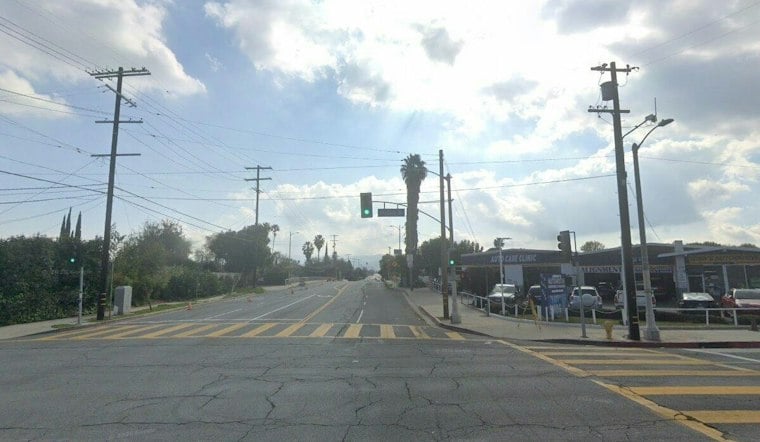
A patch of asphalt where the Los Angeles River meets Caballero Creek in Tarzana has been reborn as a park that cleans its own water with sunlight. Los Angeles civic leaders and San Fernando Valley residents gathered Monday to celebrate the opening of Caballero Creek Park, a 1.5-acre site just south of Victory Boulevard on Lindley Avenue that officials are calling the city’s first self-sustaining park.
According to MyNewsLA, the city converted a once-underutilized lot into a park that captures rainwater and runoff from both on and off the site, then uses solar power to clean that water for irrigation. The project was made possible by work from the Mountains Recreation and Conservation Authority, the L.A. Department of Recreation and Parks, the Bureau of Sanitation, the General Services Department, and Los Angeles County, the outlet reports.
A Former Concrete Lot Reimagined
Councilmember Bob Blumenfield, who represents West San Fernando Valley neighborhoods, attended the park’s opening alongside residents and dignitaries. He said the former concrete lot had been converted into an innovative park for future generations, per the same account. Blumenfield, who served on the city council for 13 years, said his work included creating multiple parks along the L.A. River and expanding the city’s bike network.
Blumenfield helped secure seven different funding sources and cut through red tape over the past few years for the project, according to his office. Reported costs for the park differ: the station’s report on Monday’s opening put the price tag at about $5.5 million split between the city, county and state, while earlier reporting from Urbanize LA put the figure at approximately $5.45 million, including $4.4 million in state funds, $750,000 from the City of Los Angeles, and $300,000 from Los Angeles County.
Wetlands Built to Filter the Watershed
The park’s design prioritizes watershed protection and stormwater treatment through a bioswale and wetland component, officials say, and the wetlands are expected to create habitat as well as clean water. Streetsblog Los Angeles reported last year that the site had long been an asphalt lot with a handful of trees, most of which were preserved during construction, and that the park would filter and store irrigation water pumped by solar energy generated onsite. That same report described an earlier construction banner labeling the project Los Angeles’s first net-zero park, and noted the site was anticipated to open that summer.
Mountains Recreation and Conservation Authority Chair George Lange said the park is a lasting, self-sustaining community asset offering recreation, education, watershed protection, and a connection to the Sepulveda Basin. Santa Monica Mountains Conservancy Chair Miguel A. Luna said the park captures and cleans stormwater, restores riparian habitat, and creates a welcoming public space along the Los Angeles River.
Classroom Space and Daily Amenities
Beyond its environmental features, the park is set to serve as an outdoor classroom for Reseda High School. Day to day, it offers an outdoor fitness center, play and recreation areas, and access to L.A. River bike paths, giving Tarzana residents a new place to gather along the waterway.
The project fits into a broader push by the Los Angeles Department of Water and Power to rethink how the city handles rain. The utility’s Stormwater Capture Parks Program aims to collect rainwater and urban runoff at seven parks across the East San Fernando Valley, with those projects together expected to capture nearly 571 million gallons of stormwater annually, according to the Los Angeles Department of Water and Power. The agency projects that citywide annual stormwater capture will climb from about 21 billion gallons today to more than 49 billion gallons by 2035, with the goal of reducing pollutants such as trash, metals and bacteria that reach the Tujunga Wash, the Los Angeles River and the ocean.





