

























































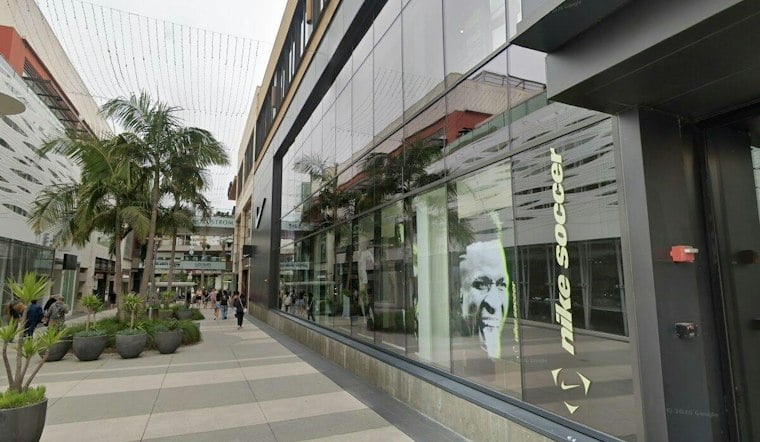
Crews are pulling old facade paneling off the former Istanbul Home at 1239 Third Street Promenade and rebuilding the retail space as Temen. Founder and executive chef Amir Al-Rashidi is aiming to open the Yemenite-French small-plates restaurant before the end of 2026, on the block between Wilshire Boulevard and Arizona Avenue.
The dining room will be small. The commercial street around it has not been. A RAND study this fall put a large share of Santa Monica’s empty retail space on the Promenade and at Santa Monica Place, so a 40-seat restaurant at this address lands in the middle of a longer argument about downtown. The Santa Monica Mirror reported today that exterior and interior renovations are already underway for that year-end debut.
A Retail Box, Taken Apart
Istanbul Home is the previous use of the address, not a theme. The space is a former retail storefront now in renovation, inside and out. The visible work, in the Mirror’s account, is crews stripping the old facade so the front can be prepared for a restaurant rather than a shop.
Temen’s own site puts the future room at 40 seats and does not dress the number up. “Forty seats. Every one considered,” the restaurant’s website says. That is a useful constraint. Shared mezze needs a table people can actually reach across, and a room that size is built for passing plates, not for a private dining annex that the plans do not mention.
Al-Rashidi is both founder and executive chef. The Mirror describes Temen as a Middle Eastern small-plates restaurant that blends traditional Yemenite flavors with French culinary discipline. Restaurant materials, as the paper reported them, trace the concept to a grandmother’s spice drawer and culinary training in Lyon. The year-end opening is a target. The Mirror did not attach a calendar date to it.
What the Early Plates Look Like
The menu being shown is organized around the middle of the table. The Mirror says it centers on shared mezze, grilled meats, and spiced dishes. An early opening spread lines up hummus, mutabbal, labneh, and warm pita, with kibbeh nayeh and kofta hawayij alongside.
The website gets more specific on one of those plates: lamb kofta with a hawaij spice blend, pomegranate molasses, and tahini. Hawaij is the Yemeni seasoning doing the work a menu might otherwise call “house spice.” The molasses pulls the meat sweet and tart; the tahini cools it. Kibbeh nayeh is the raw-lamb form of kibbeh, which makes the French-training claim more than a note about plating.
These are early previews, not a posted final menu. What they establish is the shape of the meal: dips and warm bread first, grilled and spiced meat after, meant to be shared in a room the restaurant has already decided to count chair by chair.
The Street the Numbers Describe
Temen is being built on a retail street RAND has already measured, and the measurements are blunt. The Los Angeles Times, reporting the study in October, said more than 11% of Santa Monica’s retail space was empty, and that about 45% of those empty spaces were in the Third Street Promenade and Santa Monica Place.
The Santa Monica Daily Press, also citing RAND, put a sharper figure on the pedestrian street itself: a 31% Promenade vacancy rate as of August 2026, based on 37 retail properties. The paper said at least 45% of the city’s retail vacancy was tied to the Promenade and Santa Monica Place. Citywide emptiness and Promenade emptiness are not the same number. The pedestrian core, on that August count, was running far emptier than Santa Monica retail as a whole.
The sales record behind those vacancies covers a decade. Inflation-adjusted taxable sales fell 32.8%, from $3.24 billion in 2015 to $2.18 billion in 2025, the Daily Press reported. Restaurant and bar sales fell 23.8% over that span, a decline of $151.7 million. The Times, drawing on the same RAND report, said clothing and accessory revenue declined 75% and food-services revenue dipped 24% in 2025 compared with 2015.
Apparel took the worse hit. Food and drink still lost roughly a quarter, whether the line is called restaurant and bar sales or food services. A new mezze room does not move a 31% vacancy rate. It does change one former home-goods address on the street those figures keep returning to.
Neighboring Cities Lost Less Ground
Santa Monica’s vacancy rate is also high next to the cities it is usually compared with. The Times reported West Hollywood at 9.2%, Beverly Hills at 6%, and Culver City at 5.2%, against Santa Monica’s figure of more than 11%. The spread is modest beside West Hollywood and plain beside Beverly Hills and Culver City. It is also concentrated: the Promenade and Santa Monica Place are carrying a disproportionate share of the empty space.
Sales show a wider gap. Patch, reporting the RAND findings, said Beverly Hills and West Hollywood finished 2025 about 10% to 15% below their 2015 taxable-sales baselines, while Culver City was about 25% below. Santa Monica’s inflation-adjusted drop of 32.8% is steeper than any of those peer figures as reported.
That comparison does not explain why this restaurant is here. It does describe the commercial block between Wilshire and Arizona. The Promenade remains the city’s most famous shopping street, and as of August it was also a street where nearly one in three of the retail properties RAND counted was empty.
Main Street Is on a Different Clock
A short distance away, the restaurant headlines have been running in the other direction. Forbes, in an October 16 piece, described Santa Monica’s Main Street as in the midst of its most intriguing restaurant renaissance in decades. The line was about Main Street. It was not a description of the Promenade, and reading the two as one comeback would flatten a map that is currently split.
The Forbes list is specific. Bar Fortuna, at 2917 Main Street, is an Italian-inspired cocktail and wine bar from chef Brian Bornemann. Met Her at a Bar, at 2651 Main Street, is an all-day restaurant from Mindy and Vinny Kinne. Emmanuel Dossetti had confirmed plans to open the Marseille-inspired Marseié at 2820 Main Street in fall 2026, though Forbes said an exact opening date had not been announced.
Temen is not part of that cluster, on the map or on the plate. It is a Promenade buildout with Yemenite seasoning, French kitchen training, and a room small enough that the website counts the chairs. Santa Monica can add restaurants on one commercial street while another, more famous one, is still living with a vacancy rate RAND put at 31% in August.
The target is an opening before the year ends, with hummus, mutabbal, labneh, kibbeh nayeh, and hawaij-spiced lamb kofta among the early previews. The facade paneling is coming off now. Forty seats will not close a Promenade vacancy gap measured across 37 retail properties. They will, if the debut lands on schedule, turn one former shop between Wilshire and Arizona into a dining room.





