

























































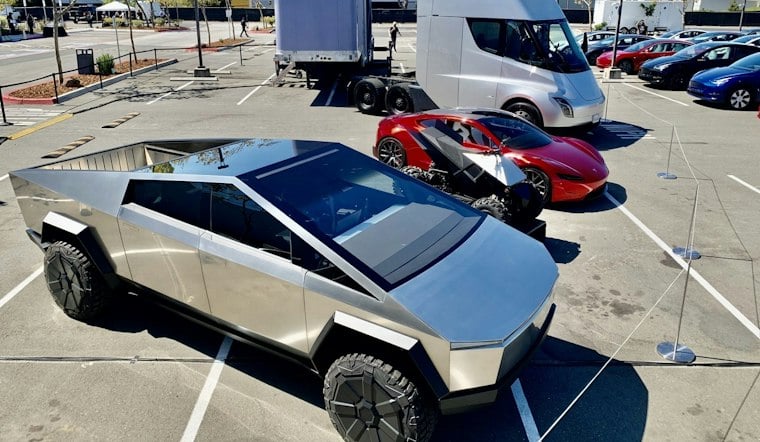
WattEV cut the ribbon Monday on its eighth heavy-duty electric-truck charging depot in California, this one planted at the Port of Oakland, and rolled out the first Tesla Semis meant to anchor a freight corridor stretching from the Bay Area toward Nevada. The depot can charge up to 25 medium- and heavy-duty electric trucks at once at up to 240 kW each, or seven trucks simultaneously at a faster 1.2 megawatts.
According to a WattEV announcement, the company introduced the first of a large fleet of electric Tesla Semi trucks slated to connect the port to freight destinations throughout the Bay Area and Northern California. WattEV says the eventual scale of that effort is substantial: more than 300 electric Semis are planned to establish what the company calls a zero-emission freight corridor running from the Bay Area to Sacramento, the Central Valley, Nevada, and beyond. As TeslaNorth.com reported, the Oakland depot is open not just to WattEV's own Tesla Semis but to other electric truck fleets as well.
Built for Speed, Not Just Capacity
WattEV designed the Oakland site around megawatt charging specifically to cut down wait times, with charging dwell times of 30 minutes or less, the company said in its release. That kind of turnaround matters for freight operators trying to keep trucks moving rather than parked at a plug, and it puts the Oakland depot in the same technical category as the megawatt charging infrastructure other operators are racing to build across the state.
Power delivery is coming through Pacific Gas & Electric's Flex Connect program, which the utility says is getting WattEV online faster. With Flex Connect, were connecting WattEV to the grid faster by using smart technology to make the most of the grid we already have, a PG&E representative said in the announcement. The program is built to help operators tap into existing grid capacity rather than waiting on new infrastructure buildouts.
Cost Claims and a Statewide Network
WattEV also says the economics are starting to favor electric over diesel on a per-mile basis. The company stated that the per-mile energy cost to fuel these new electric big rigs is less than that of comparable diesel trucks, given current diesel fuel prices — a claim tied specifically to energy costs rather than the full expense of owning and operating a truck.
The Oakland depot joins seven existing WattEV sites around the state, including locations at the Port of Long Beach, Bakersfield, San Bernardino, Gardena, Vernon, Oxnard, and Fresno, per the company's release. That spread gives WattEV a presence stretching from Southern California's ports up through the Central Valley and now into the Bay Area, forming the backbone for the freight corridor the company envisions linking Oakland to Sacramento and points beyond.
A Crowded Race to Build Megawatt Chargers
WattEV isn't alone in chasing this infrastructure. Forum Mobility has said it's building four new California depots, including two in Oakland, and reported more than 40 MW of CCS and MCS charging capacity online or under construction, according to a PR Newswire release. Forum Mobility separately added two Megawatt Charging Standard chargers at its FM Harbor depot near the Port of Long Beach, an event that featured MCS charging of a customer's production-model Tesla Semi, as detailed by Charged EVs. That company has also said 25 carriers now hold contracted charging capacity with it, alongside customer reservations for more than 330 Tesla Semis.
Farther south, EV Realty has broken ground on a 9 MW charging hub in Torrance expected to open to commercial fleets by mid-2027 with 50 charging ports, 20 of them rated for Megawatt Charging System use at up to 1.2 MW and the rest standard DC fast chargers up to 350 kW, according to FreightWaves. That $22.1 million project, which includes a $7.9 million state grant, is aimed at trucks serving the ports of Los Angeles and Long Beach, inland distribution centers, and air cargo around LAX. EV Realty has said it expects next-generation trucks such as the Tesla Semi to be rolling out at scale by the time the Torrance site opens, and it's targeting more than 100 MCS ports across Southern California by mid-2027.
Tesla's Own Charging Network Lags Behind Schedule
All of this expansion is happening as Tesla's own public Megacharger buildout falls well short of its stated goals. As of November 18, Tesla's public Megacharger map showed just seven sites and 44 stalls across four states, according to Electrek. That's a steep gap from the roughly 37 sites Tesla's own Q4 2025 shareholder report had projected for 2026, and further still from the 46 sites Semi program lead Dan Priestley has said Tesla wants by early 2027. Electrek calculated that hitting even the 37-site target would require Tesla to open 30 more sites in the 43 days remaining in the year — a pace the outlet described as far from achieved.
Some of Tesla's public charging footprint is coming through partnerships rather than its own buildout. Per Yahoo Finance, Tesla will operate public Megacharger facilities at three Forum Mobility depots — FM Francis in Ontario, and FM Adeline and FM Coliseum in Oakland — as part of a planned 30-megawatt expansion across four Forum Mobility sites in Northern and Southern California. Forum Mobility's existing FM Harbor depot has been operational since December 2024 and already includes 44 CCS charging ports with 9 megawatts of total capacity, the same report noted.




