

























































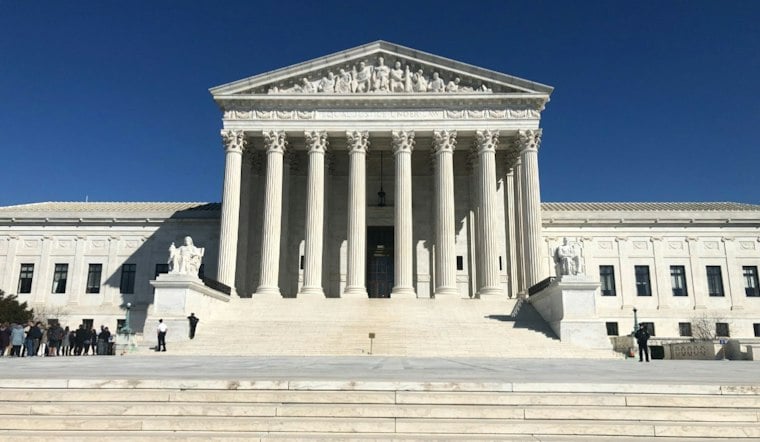
A disbarred Texas lawyer serving 20 years for racketeering wants the Supreme Court to let him use a habeas corpus petition to jump the line into a halfway house or home confinement, arguing prison officials shorted him months of credit he says he earned. The justices heard oral arguments Monday in a case that could reshape how thousands of federal prisoners challenge the Bureau of Prisons over First Step Act time credits.
The case, Maxwell v. Dinis, asks whether William Maxwell can bring his claim under 28 U.S.C. § 2241, the federal habeas corpus statute, rather than through a separate civil lawsuit, according to the Legal Information Institute at Cornell Law School. Maxwell, who is incarcerated in Texas, was convicted in New Jersey in 2014 of racketeering conspiracy and related offenses after taking over and defrauding a mortgage loan company, and he says the Bureau of Prisons failed to account for some of his qualifying activities, denying him between 42 and 48 months of time credits, as reported by Spectrum News.
Maxwell began seeking to apply those credits toward prerelease custody in 2020, and after being repeatedly denied a transfer, he filed his habeas petition in 2022, per the same Cornell Law School summary. Lower courts rejected his argument that he could use habeas corpus to seek a transfer to a halfway house rather than full release, Spectrum News reports, and the Fifth Circuit affirmed the dismissal, holding that First Step Act claims like his simply do not fall under the habeas statute.
Oral Arguments Center on One Disputed Number
Maxwell's attorney, Masha Hansford, told the justices her client claimed federal law required his release from prison and transfer to home confinement or a halfway house, according to Spectrum News. Justice Samuel Alito pressed on whether Maxwell had actually satisfied all four requirements for pre-release custody, and Hansford confirmed that he had — with Spectrum News noting that Maxwell has the lowest recidivism rating, a qualifying offense, and has met every other pre-release requirement. By the article's account, Maxwell's disputed time-credit calculation is the only issue still in dispute.
Brian Barnes, appointed to defend the lower court's decision, argued that a habeas petition was the wrong vehicle because Maxwell is seeking a change in where he serves his sentence, not complete release from custody. Barnes warned a ruling for Maxwell could invite a wave of new appeals from current and future inmates, and said a future appeal under that theory could even seek a transfer from a medium- or low-security prison to a prison camp, Spectrum News reports.
The government also raised a wrinkle that surprised observers: Assistant to the Solicitor General Kevin J. Barber told the justices Maxwell's approaching release could make the whole appeal moot, urging the Court to dismiss the case as improvidently granted, according to Law360 Pulse. Barber acknowledged that the government had not raised that mootness argument when the Court was initially deciding whether to hear the case at all, the outlet reported. Maxwell is reportedly set for release from prison on Jan. 22, 2027, and the federal government has suggested he would become eligible for a halfway-house transfer on that same date, per Spectrum News — timing that both sides' lawyers urged the justices to resolve the case before.
A Circuit Split and a Law Still Being Implemented
The Supreme Court granted Maxwell's petition for certiorari on June 1, 2026, according to the Cornell Law School summary. Maxwell's filings describe a circuit split: the Eighth Circuit reached the same conclusion as the Fifth, while the First, Second and Third Circuits have ruled the opposite way, as detailed by Law360.
Jessica Levinson, a professor at Loyola Law School, said federal prisoners may use a habeas petition to argue they are entitled to early release under the First Step Act, per Spectrum News. Based on the tenor of oral arguments, Levinson said a majority of justices appeared inclined to support Maxwell's appeal, though she cautioned that any ruling in his favor could be written narrowly.
The First Step Act, signed into law by President Donald Trump in 2018, lowered mandatory minimum sentences for certain nonviolent federal offenders and let eligible prisoners earn time credits toward early release, according to Spectrum News. Monday's arguments marked the seventh case involving the law to reach the Supreme Court, the outlet previously reported, following the Court's 2026 ruling in a separate case the Washington Examiner says resulted in a 6-3 decision that changes to mandatory minimum sentences cannot be applied retroactively.
The stakes extend well beyond Maxwell's own case. Spectrum News reported that the Bureau of Prisons credits the First Step Act with sentence reductions for more than 66,000 federal inmates, and cited a 2024 Council on Criminal Justice report finding a 55% drop in recidivism among people released under the law. But the same report found Government Accountability Office reviews have identified gaps in the Bureau's data and concluded the agency still has not fully implemented the law eight years after its passage — a shortfall Spectrum News illustrated by noting that Texas residential reentry center beds could accommodate only 11% of the federal inmates released into the state in 2025.





