

























































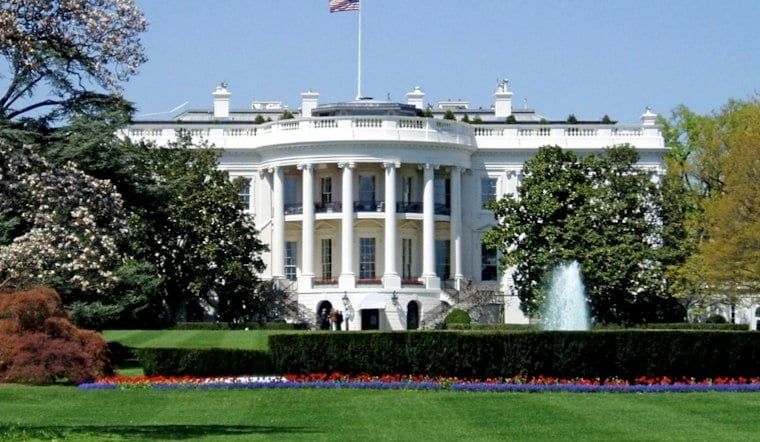
President Donald Trump spent Election Day largely out of public view, keeping a schedule of closed-door meetings at the White House before hosting a nighttime reception to watch results come in, capping a month of rallies aimed at helping Republicans hold Congress.
Trump was scheduled to remain at the White House into the evening while states counted votes, according to a White House official cited by TIME. His day began with executive time at 8 a.m., followed by policy meetings at 11 a.m. and 12:30 p.m., a 1:30 p.m. meeting in the Oval Office with the U.S. ambassador to Portugal, another policy meeting at 2:30 p.m. and signing time at 4 p.m., according to KABB. Every one of those events was closed to the press, the station reported, and Trump was set to host a closed-door reception in the East Room that night to watch midterm results.
WALB confirmed the broad outline of that schedule, reporting that Trump would take part in morning and afternoon policy meetings closed to the press, meet with the ambassador to Portugal in the afternoon, and later attend a midterm elections viewing reception at the White House that was also closed to the press, according to WALB.
A Final Push at the Reflecting Pool
The closed-door Election Day schedule followed a month of visible campaigning. Trump held nearly 30 rallies across the country during October, per KABB, and TIME reported he attended at least nine virtual tele-rallies for Republican candidates on the Monday before Election Day alone, on top of 27 campaign rallies during the month.
His final pitch came Monday afternoon at the Lincoln Memorial Reflecting Pool in Washington, D.C., which had reopened after repairs, according to TIME. He spent about 20 minutes touting the pool renovation and other Washington projects, called the 2026 midterm the most important of his lifetime, and criticized Democratic candidates as “extreme and dangerous,” per KABB. He also acknowledged that the sitting president's party often loses midterm elections, the station noted. Trump and First Lady Melania Trump had already cast their ballots early in person in West Palm Beach, Florida, two weeks before Election Day, TIME reported.
Approval Near Record Low as Affordability Dominates
The closed-door schedule played out against polling that showed Trump's standing near its lowest point of his second term. A Reuters/Ipsos poll released Monday put his approval at 32%, unchanged from the previous week and just one percentage point above the record-low 31% he hit in October, according to USA Today. Other averages told a somewhat different story: the RealClearPolitics average put his approval at 39.3% with 58.8% disapproval, the New York Times average showed 37% approval and 60% disapproval, and Nate Silver's Silver Bulletin average showed 38.4% approval and 58.8% disapproval, the outlet reported.
Generic congressional ballot polling also varied by survey. The same Reuters/Ipsos poll gave Democrats an eight-point advantage, down from 11 points the previous week, while an AtlasIntel poll released over the weekend showed a 14-point Democratic lead, per the USA Today report. Election forecaster VoteHub gave Democrats an 89% chance of winning the House, projecting 234 seats, and a 68% chance of taking the Senate, with 52 seats projected, the outlet noted. A Monday New York Times/Siena poll separately showed Democrats leading in Senate battlegrounds including Michigan, Texas, Ohio and Kansas, according to TIME.
Cost of Living Tops Voters' Concerns
Polling consistently pointed to affordability as the dominant issue on voters' minds. A Reuters/Ipsos survey found that 48% of registered voters ranked cost of living as the most important factor in deciding their midterm vote, compared with 26% who cited democracy and 13% who cited immigration, according to The Hill. That same survey, conducted online among 1,765 U.S. adults with a margin of error of 2 percentage points, found that 49% of Americans said their financial situation had worsened during Trump's second term, while 13% said it had improved and 37% reported little change, the outlet reported. AAA figures cited in the report showed the national average price of gas at $4.15 per gallon Tuesday morning, more than a dollar higher than a year earlier.
A separate Reuters-Ipsos poll found 50% of registered voters considered cost of living the single most important factor shaping their vote, including 53% of Republicans and 49% of Democrats, according to CNBC TV18. GasBuddy figures cited in that report showed national gas prices had risen roughly 46% since January 2025, while a Council on Foreign Relations-Morning Consult survey found 75% of respondents worried about affording groceries, with 83% of those concerned blaming tariffs for making things worse. KABB additionally reported that the war in Iran has added to voters' affordability concerns and raised questions about its cost, duration and effect on gasoline prices.
Stakes for Trump's Final Two Years
Trump campaigned to help Republicans keep control of Congress, and the results carry direct consequences for the remainder of his term. If Democrats win either chamber, they could complicate his legislative agenda, according to KABB. A Democratic majority could also expand congressional investigations and oversight during his final two years in office, and a Democratic House majority could pursue impeachment proceedings, the outlet reported.




