

























































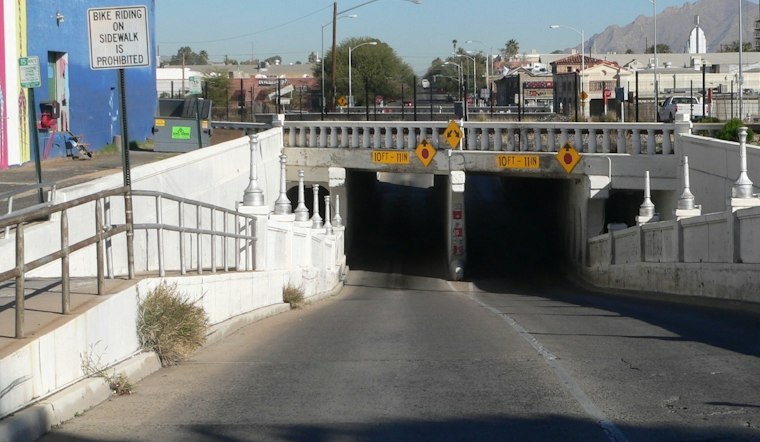
The Sixth Street Underpass is now open beneath the Union Pacific Railroad tracks, giving pedestrians, cyclists and drivers a route across the tracks without using a street-level crossing. City officials held a ribbon-cutting Friday, Nov. 6, for the Downtown Links project, according to KVOA and KGUN 9. The corridor connects Sixth Street with the Interstate 10 corridor.
What the corridor includes
The finished route combines a roadway, bicycle lanes, sidewalks, a shared-use path, an overpass and the rail underpass, KGUN 9 reported. KVOA reported that the project also includes a deck plaza at Ninth Avenue, a connection to the Ninth Avenue bike boulevard, landscaping, public art and underground storm-drain infrastructure.
The underground box culvert is designed to help reduce flooding in downtown Tucson and nearby neighborhoods affected by the Tucson Arroyo, according to KGUN 9. The Downtown Links project FAQ says the drainage work could allow nearby properties to be removed from the Federal Emergency Management Agency floodplain, but that remains a possibility rather than a confirmed outcome.
Flood exposure near downtown
For context on the flood risk near the corridor, the Pima County Regional Flood Control District says its analysis indicates a shallower floodplain extends from 4th Avenue west to just upstream of Main Avenue. The county finding identifies floodplain exposure in part of downtown; it does not establish that the drainage work has removed nearby properties from the FEMA floodplain.
The Regional Transportation Authority describes the completed corridor as 1.3 miles long, from Maclovio Barraza-Aviation Parkway to the Interstate 10 frontage road. KGUN 9 reported that Vice Mayor and Ward 1 Council Member Lane Santa Cruz said neighborhood residents helped retain pedestrian and bicycle connections in the final design.
A long-planned link
Downtown Links grew out of a concept dating to the 1980s; the original Palo Verde-to-Broadway section was built in the 1990s, according to the Regional Transportation Authority. Tucson took over the roadway concept from the Arizona Department of Transportation in 1989 after an earlier highway proposal threatened significant property losses in the Historic Warehouse Arts District. KGUN 9 reported that more than 20 route options and alignments were considered before the city approved its current general alignment in 2008.
Voters approved the RTA’s 20-year transportation plan in 2006, which included Downtown Links. The project FAQ and KGUN 9 report $76.1 million in RTA funding and $8.5 million in regional Highway User Revenue Fund dollars. KGUN 9 also reported that RTA executive director Michael Ortega said the drainage work helped secure financial support from Pima County.
The latest phase began construction in August 2020. The eastern segment, connecting Barraza-Aviation Parkway to Sixth Street, opened in February 2023. Coordination with Union Pacific Railroad and a fiber-optic utility company complicated work on the western segment and contributed to delays, KGUN 9 reported. The RTA lists the west-end roadway section as completed in 2014 and the east-end section in 2023. The project FAQ gives costs of $7.4 million for a 2012 drainage phase along 8th Street and $7.3 million for the 2014 reconstruction of St. Mary’s Road.
Costs also exceeded projections during an earlier phase. The Arizona Daily Star reported that the city rejected three bids after they came in above the engineer’s estimate. The lowest, from Granite Construction, was $55.4 million, 42% over the projection.



