

























































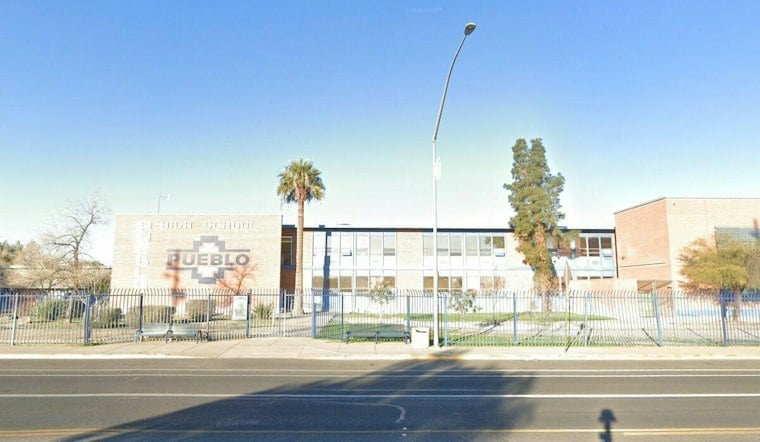
A Pueblo High School student is alive today because the adults around him did not hesitate when his heart stopped beating during basketball practice. This week, the Tucson Unified School District campus brought that student face-to-face with the people who kept him breathing until paramedics could take over.
Pueblo High School, part of the Tucson Unified School District, organized the reunion to bring together everyone who played a role in saving the teenager during the cardiac arrest, according to KGUN 9. When the student collapsed on the court, school staff jumped into action immediately, starting CPR and using an automated external defibrillator before emergency crews even arrived, the station reported.
By the time Tucson Fire Department crews got there, the groundwork had already been laid. Crews continued life-saving efforts on scene, and the student regained a pulse and survived, per the same report. School staff said they wanted to show their appreciation and give the student and everyone else involved that day a chance to finally meet the fire department crew members who responded.
How Tucson Fire Crews Work a Cardiac Arrest
Tucson Fire Department uses a technique called Pit Crew CPR, which assigns paramedics specific roles rather than having everyone work at once. As KOLD reported, paramedics rotate in to deliver 200 chest compressions at a time while others handle oxygen, distribute medicine, and monitor the defibrillator. The department's medical director said Tucson Fire's out-of-hospital cardiac-arrest save rate sits at 11%, well above the national rate of 7 to 8%, the station noted.
That approach has shown up in other local survival stories. The outlet's report also described how Chuck Erickson survived an out-of-hospital cardiac arrest after his wife performed chest compressions for eight minutes before paramedics arrived and continued CPR. The department recently added 14 paramedics to its workforce and planned to add 24 more the following year, according to the station's reporting.
A Pattern Seen Across Tucson
This is not the first time Tucson has seen a cardiac-arrest survivor reunited with the people who saved them. Five people were once recognized at Tucson Fire Central for helping save Larry Oremland after he suffered cardiac arrest at the Tucson Racquet Club, with bystanders performing CPR and using an AED that got his heart pumping again within four minutes, per KOLD's earlier coverage. Fire crews arrived afterward and continued his care using a monitor purchased with Prop 101 funds, the outlet reported.
Research on young athletes nationally shows why fast, layered response matters so much. A study published in the Journal of the American College of Cardiology examined 641 young competitive athletes who experienced sudden cardiac arrest between July 2014 and June 2023 and found overall survival of 49%. Among athletes whose cardiac arrest occurred during exercise, survival rose to 57%, and the study found survival improved during the nine-year window it covered.
What the Research Says About Timing and Access
The same study found that survival was notably higher for athletes who collapsed during a game or competition compared with practice or training, at 70% versus 53%. A separate study in the British Journal of Sports Medicine looked at 111 U.S. high school student-athletes with exercise-related cardiac arrest between 2014 and 2018 and found 75, or 68%, survived. That research also found survival rates climbed to 83% when an athletic trainer was on-site and 85% when an on-site AED was used, underscoring why current best-practice recommendations call for AED access within three minutes of collapse.
The same research identified a troubling gap: minority student-athletes in that study had a lower survival rate than white non-Hispanic student-athletes, 51.1% compared with 75.9%. The American Heart Association has reported that more than 23,000 children experience cardiac arrest each year, with 40% of those incidents tied to sports, according to Tucson.com.
For now, the focus at Pueblo High School stayed on gratitude rather than statistics. A student who collapsed during a basketball practice is alive because a group of school staff and firefighters did their jobs in sequence, without pause, and this week they finally got to stand in the same room and see the result of that work.



