

























































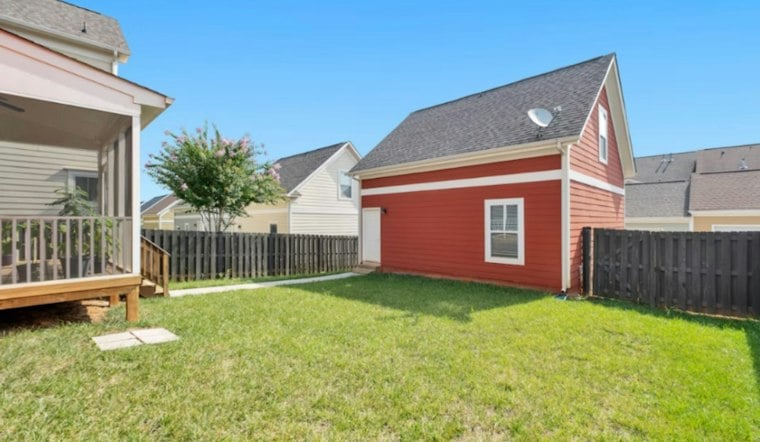
For Amelia and Sydney Stoker, 39-year-old twins, family life runs across two neighboring homes: seven adults on the property help care for five children under five. The sisters and their husbands created the arrangement after buying the house next door and removing the fence between their backyards.
The neighboring home went on the market in July 2022, according to Business Insider. Sydney Stoker and her husband, Paden Roder, bought the four-bedroom, two-bathroom house later that summer. Sydney said her brother-in-law persuaded them to consider the purchase, which would put their family next to Amelia Stoker and her husband, Adam Fagin.
The purchase came as the sisters’ orthodontics practice, Twin Smiles Orthodontics, found a building available for them to work in together. The couples had been considering other options: Amelia and Fagin looked into an oral-surgeon job for him across the country, while Sydney and Roder considered moving back to Portland, Oregon. Fagin’s family kept the three-bedroom, two-bathroom home where he grew up, renting it out while he finished his education; his parents later moved down the street.
Tearing Down the Fence, Building a Shared Life
The two households removed the fence between their backyards, giving the children room to move between the properties. Sydney and Roder’s children were four, two and a newborn; Amelia and Fagin’s were four and two. Each home has an accessory dwelling unit (ADU) out back. The families hired two au pairs together to care for all five children, and one ADU houses them; the other is usually where the Stoker sisters’ mother stays when visiting.
The second ADU’s use has shifted: Sydney’s mother-in-law has been staying there in recent months while Sydney and Roder convert their garage into a permanent home for her. Amelia’s in-laws live down the street. Together, the arrangement puts seven adults on the property full time to help manage family life.
Weeknight Dinners and a Shared Credit Card
The households share dinner every weeknight and rotate cooking. Amelia’s family cooks Tuesdays, Sydney’s Thursdays, and Sydney’s mother-in-law covers Mondays, Wednesdays and Fridays. They also use a shared credit card for compound-related costs; Sydney said her sister typically uses it for the weekly Costco trip.
Both Sydney and Roder work full time, and the sisters told the outlet that the arrangement makes raising their children easier. “I feel like we can have a third kid because of the compound,” Sydney said. Amelia said the help gives her more free time than her friends have.
A Different Kind of Childhood — for Kids and Adults Alike
The adults describe the arrangement as a source of everyday company as well as practical help. Roder said the children have playmates next door and are building close relationships by living near one another, while the presence of another adult often makes caring for young children easier. Sydney said she values seeing her nieces grow up day to day.
Part of a Bigger Housing Shift
The Stokers' setup echoes a broader trend researchers have tracked for decades. In March 2021, 59.7 million people in the United States were living in multigenerational households — about 18% of the population — according to the Pew Research Center. That figure has quadrupled since 1971, when such households made up just 7% of the population, Pew found. The organization defines a multigenerational household as one with two or more adult generations, or a “skipped generation” of grandparents living with grandchildren younger than 25.
Austin’s Rules for Building an ADU
For readers considering a similar setup in Austin, Development Services defines an Additional Dwelling Unit as a separate dwelling on the same property as a single-family home. The department says a residential property may have an ADU if it is zoned SF-1, SF-2 or SF-3 and has a minimum lot area of 5,750 square feet, according to Austin Development Services.
On the Stoker-Fagin property, the ADUs have housed au pairs and a visiting relative.





