

























































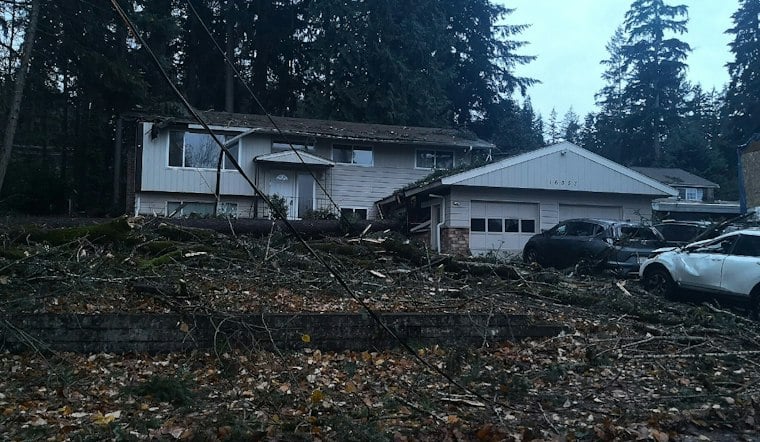
Two women died and hundreds of homes and businesses were damaged when a bomb cyclone tore through Western Washington on Nov. 19, 2024, bringing hurricane-strength gusts, rain and snow that knocked out power to more than half a million customers. Two years later, the storm's financial and emotional toll is still being counted, with public repair costs that eventually topped $34 million and Washington's initial request for a federal disaster declaration and subsequent appeal both denied.
A Deadly Night Across the Region
The storm killed two people in Western Washington and knocked out power to more than a half-million customers, according to KIRO 7. One woman died after a tree fell on a homeless encampment in Lynnwood, while another died after a tree crashed into her Bellevue home, per the seed reporting from KOMO News. Winds were clocked at 74 mph around Enumclaw as the storm toppled trees onto homes and across roads and power lines from Issaquah to Lake Stevens and North Bend.
Puget Sound Energy alone reported nearly half a million customers without power in its service area, KIRO 7 notes, and the utility's high-voltage transmission system sustained damage that complicated restoration efforts. Some neighborhoods lost power even where lines were buried underground, and some families waited nearly a week for electricity to return. Nearly a week after the storm, thousands of customers were still in the dark, the station's report adds.
Two Years of Rebuilding, and a Rejected Appeal
The scale of destruction has drawn comparisons to past Pacific Northwest windstorms. KOMO described the 2024 bomb cyclone as one of western Washington's most destructive windstorms in six decades, though the station notes the 2006 Hanukkah Eve and 1962 Columbus Day storms produced stronger peak gusts at some locations. The November 1981 Friday the 13th Windstorm, by comparison, knocked out power to about 400,000 homes and businesses, per the same KIRO 7 account.
Public property damage and repair costs eventually exceeded $34 million, including $14.7 million in King County alone. Yahoo News reported that the $34 million tally spanned six counties, with the majority of the damage concentrated in King and Snohomish counties. Issaquah's own costs have been reported two different ways: KIRO 7 put the city's general-fund spending at about $2.4 million, while Stateline reported the city's total storm costs at $3.8 million, covering road repairs, removal of 800 tons of tree debris and overtime pay for first responders.
Federal Aid Denied Twice
FEMA denied the state's request for a major-disaster declaration and later denied its appeal, according to KIRO 7's reporting. In response, then-Gov. Jay Inslee signed an emergency proclamation in January 2025 that unlocked $1 million in state funding for recovery, and the Small Business Administration made low-interest disaster loans available in seven Washington counties.
For some homeowners, the road back took close to a year to complete repairs, and residents have said the repairs and lessons from the storm remained part of daily life two years later. In Mirrormont, homeowner Cathy Cadd told FOX 13 Seattle, “We lost 13 trees,” and said her family was forced to spend 11 days in a hotel after the storm hit.





