

























































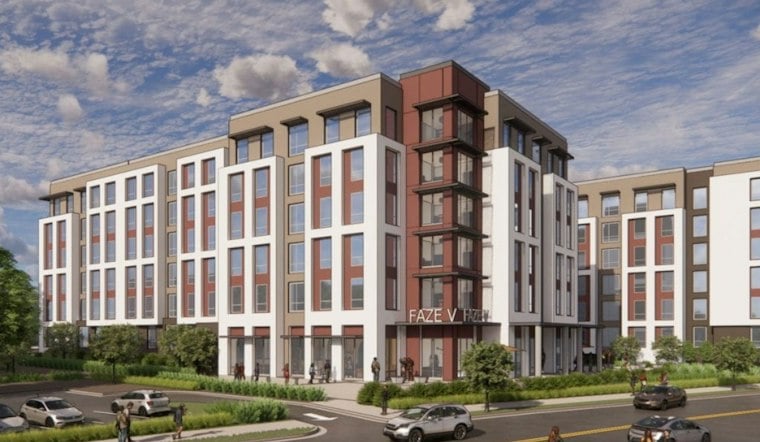
UC Irvine has broken ground on two six- to seven-story apartment buildings on the east side of campus, the fifth phase of its East Campus Student Apartments and the university's latest attempt to close a persistent gap between how many students want to live on campus and how many beds exist. The project is planned to add approximately 1,065 beds in 308 apartment units across 3.2 acres, with projected fall 2028 rents of $982 to $2,017 per bed per month — about 34% below comparable market rates.
A Fifth Phase Near Puerta del Sol
According to UC Irvine News, the new buildings will occupy two sites near the existing Puerta del Sol apartments along Campus Drive, land that currently holds a vacant office building and a surface parking lot. The project is set for completion in time for fall 2028 occupancy and is supported through a public-private partnership development model financed with tax-exempt bonds, rather than built and paid for directly by the university. Notably, there will be no dedicated on-site resident parking, per the same account.
A separate bond-issuer disclosure offers a slightly different capacity figure: the California Statewide Communities Development Authority describes the project as planned to add approximately 1,067 beds for both undergraduate and graduate students, while UCI's own figure is approximately 1,065. CSCDA announced issuance of $191,380,000 in tax-exempt revenue bonds for the project on Oct. 22. Per that filing, the completed apartments will be owned by CHF-Irvine, L.L.C. and operated by American Campus Communities.
Financing Structure and Affordability Math
The financing arrangement threads together a university that needs more beds with a nonprofit structure built to deliver them without draining campus coffers. As reported by the Orange County Business Journal, UCI is developing the project at a cost of $165 million in partnership with the Collegiate Housing Foundation, a tax-exempt nonprofit that helps universities finance, construct and operate student housing. Under that arrangement, the foundation leases the land from UCI and owns the housing project itself, with American Campus Communities handling day-to-day management; ownership transfers back to UCI once the bonds are fully repaid through project revenue, according to the same report.
The projected rents of $982 to $2,017 per bed, drawn from 2025-26 UCI rent data per the Business Journal's reporting, are pitched as roughly 34% less than apartment rents within 1.5 miles of the university. For comparison, the outlet notes that nearby University Town Center lists average monthly rent of $1,875 for one-bedroom apartments, with three-bedroom units running as high as $5,000 a month, according to RentHop data cited in that report. UCI campus apartments already operate near full capacity, at 99.8% occupancy per the university's own figures cited by the Business Journal.
Who Gets a Bed, and Who Waits
The new East Campus apartments are intended to serve sophomores, juniors and seniors, according to the Business Journal's reporting. UCI guarantees undergraduate housing to first-year and transfer students who live on campus for the full academic year, and separately guarantees housing to certain graduate students, including PhD and Master of Fine Arts students, per the same account. Brice Kikuchi, identified in that reporting, said UCI supports its current housing guarantee but maintains a waitlist for continuing students who fall outside the guaranteed category.
That waitlist pressure shows up in university housing data. As of Aug. 21, UCI's graduate housing waitlist listed 460 Category 1 students and 639 Category 2 students, according to UCI Student Housing, which states that placement from the waitlist is not guaranteed. A University of California Regents filing found continuing-undergraduate housing occupancy at 99.8% as of October 2025, with a waitlist of 5,065 students at that time.
Building Cheap by Building Simple
Kikuchi, per the Business Journal, said building beds without extensive amenities helps keep the project more affordable for student renters, and noted that Plaza Verde was UCI's first attempt at a higher-density housing product. The new apartments will include study rooms and common areas, according to that reporting. Kikuchi also said UCI may consider infill development or redevelopment of older, lower-density housing if the university pursues additional capacity down the line — some existing UCI housing facilities date to 1965, per the same account.
UC Irvine's broader numbers underline how much ground the campus has covered. The university reported 18,003 beds on campus in fall 2026, with 50% of students living on campus, and says Phase 5 will push on-campus housing above 50% of undergraduates for the first time as it works toward a long-range goal of housing 60% of students on campus, according to UC Irvine News. The Business Journal separately reported that UCI has about 18,000 beds currently and plans to increase campus housing toward 22,000 beds. UCI says its student housing capacity grew nearly 40% over the decade preceding fall 2026, adding approximately 5,800 new beds in that span.
How the Pieces Stack Up
Phase 5 joins a string of recent additions to UCI's housing stock. Vista del Campo opened in 2004, followed by Vista del Campo Norte, Camina del Sol and Puerta del Sol, the Business Journal reported. Plaza Verde opened in 2019 with 1,400 beds for continuing students, and Plaza Verde II added 1,077 beds in 2023, according to UC Irvine News. Verano 8, a $221 million complex, added 1,055 beds across five seven-story towers when it opened in 2022, while Oso Tower opened in fall 2025 with 424 undergraduate beds, per the same source.
The squeeze on student housing extends well beyond Irvine. California committed $2 billion in 2021 to grants for student housing at public colleges and universities, and that funding has helped produce more than 9,000 additional beds statewide, according to EdSource. Completed projects funded through that statewide effort have averaged $251,000 in construction cost per bed — for context, EdSource reports a 1,423-bed UC San Diego dorm that opened in 2024 cost $260,000 per bed, while two CSU Northridge residence halls that opened in 2025 cost $360,000 per bed for just 200 total beds.





