

























































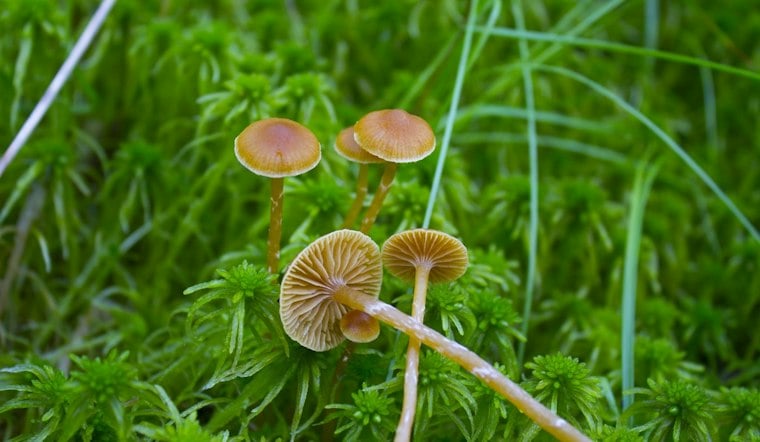
A small brown mushroom collected at a University of Florida biological station is the first known to make both psilocybin and amatoxins, a family of compounds that includes some of the deadliest poisons in fungi.
Researchers have dubbed the species Galerina indica the "dark magic mushroom." The nickname is less a flourish than a problem of identification: the mushroom is hard to separate from other little brown species, even for a trained expert, according to the University of Florida.
A First Florida Report from a Station Survey
Andrew Kunik found the mushroom while documenting fungi at the UF/IFAS Ordway Swisher Biological Station. He was then an undergraduate working in the lab of Matthew E. Smith, a professor in the UF/IFAS Department of Plant Pathology, Florida's state mycologist and the study's senior author.
The group had been working through the genus Galerina to check Florida for amatoxin-containing species that had not been documented. Galerina already includes mushrooms that carry those toxins. This one also carried psilocybin.
Kunik did the bioinformatics and genome work. "I did the bioinformatics and genome work, and Michael did the chemical analysis," he said in the university account, referring to Michael Christopher. Kunik has since continued studying fungi as a postbaccalaureate researcher at Harvard.
Two Chemistries in One Mushroom
A Nature report on the work called G. indica the first mushroom known to make both the hallucinogen psilocybin and lethal compounds from the amatoxin family. That family includes poisons found in the death cap, Amanita phalloides. Amatoxins can cause fatal mushroom poisonings. The underlying study, led by Kunik and colleagues, was published in Current Biology in 2026.
Chemical analysis found a previously undescribed amatoxin the team is calling alpha-proamanitin, Symplexia News reported. Christopher and Timothy Garret, who also worked on the project, are in UF chemistry. The mushroom stains blue when handled.
Psilocybin is the compound in so-called magic mushrooms that can produce psychedelic experiences. Kunik has said researchers still do not fully understand why mushrooms make it. Finding it beside amatoxins in a single species does not answer that question. It does put two familiar fungal reputations in the same cap.
A Genus Already Treated Carefully
The university account is blunt about the look of the thing: "It's hard to differentiate from others, even for a trained expert." G. indica is also difficult to find. A blue bruise is not a field guide.
Smith identifies poisonous or potentially poisonous species and consults Florida poison control, emergency-room doctors and veterinarians. That consulting work is the unglamorous end of mycology, and a new little brown in an already toxic genus is exactly the sort of specimen that makes it necessary. The reporting does not tie G. indica to a specific human poisoning.
Earlier mapping of the genus already showed how uneven those toxins are. A 2021 phylogenetic study in PLOS ONE detected amatoxins only in 24 sampled specimens from the Galerina marginata sensu lato complex, within the Naucoriopsis clade. Amatoxins were not detected in 46 samples from Galerina clades outside Naucoriopsis or from outgroups. The Florida project was aimed at species those earlier surveys had not pinned down.
Defenses, Borrowed Genes and an Unsettled Tree
Researchers say amatoxins may help protect mushrooms from animals that eat them, but their precise ecological role is not clear. The same uncertainty hangs over psilocybin. A plausible defense is not the same thing as a demonstrated one.
Ancestors of these mushrooms likely acquired chemical-production genes through horizontal gene transfer, though the evolutionary pathway for the psilocybin genes remains uncertain. There is not enough known about the fungi's family tree to sort out which scenario is correct, Symplexia reported.
The collaboration stretched past Gainesville. Alongside Kunik, Smith, Christopher and Garret, the team included Ben Lemmond of the Smith lab, Bryn Dentinger at the University of Utah and Jason Slot at Ohio State University.
What a Gene Knockout Could Show
The researchers expect future experiments may clarify how a mushroom benefits from producing amatoxins, psilocybin or both. One approach they have described is knocking out the genes for either compound and then seeing how the fungus is affected.
That test is still ahead of them. What the Current Biology paper establishes is narrower, and stranger: one hard-to-spot Florida mushroom carrying a hallucinogen and a newly described amatoxin at the same time.




