

























































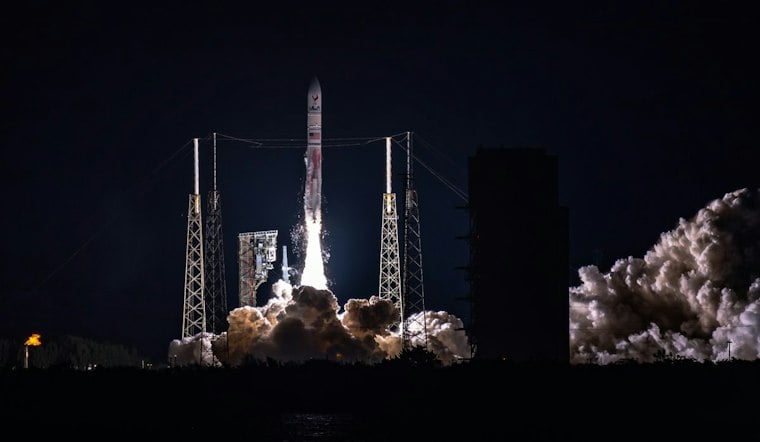
United Launch Alliance's Vulcan rocket is set to lift off from Cape Canaveral Space Force Station on Friday carrying 40 Amazon Leo satellites, marking the vehicle's return to flight after a nine-month grounding tied to booster problems. The launch window opens at 12:54 p.m. ET and lasts 29 minutes, with liftoff planned from Space Launch Complex 41.
The mission, known as Vulcan Leo 1, is Amazon's largest Leo payload delivered to date, according to Amazon. It's also the first of 38 launches Amazon has under contract with ULA as part of a broader plan to loft more than 1,500 first-generation Leo satellites across those missions. Amazon's full constellation is designed to eventually include 3,236 satellites, per Light Reading.
Friday's flight will be Vulcan's fifth since the rocket debuted in 2024, and the first to fly with six strap-on solid rocket boosters, according to Spaceflight Now. That configuration comes after nozzle failures on the Northrop Grumman-built solid rocket boosters forced ULA to ground Vulcan for nine months. The outlet reports that ULA will fly an improved nozzle design on this mission, with additional testing and analysis continuing in parallel.
A Rocket Built to Replace an Aging Fleet
Vulcan is intended to eventually replace both ULA's Atlas V and its now-retired Delta IV rocket families, as reported by Florida Today. The same outlet notes Vulcan can carry up to 60,000 pounds to orbit, roughly 10,000 pounds more than SpaceX's Falcon 9 can transport to low Earth orbit. ULA rolled the rocket out to the pad Thursday morning ahead of the planned launch, as first reported by the Orlando Sentinel.
Teammates representing United Launch Alliance, Amazon, U.S. Space Force and FAA gathered for the Vulcan Leo 1 Launch Readiness Review and declared the rocket, its payload and mission-support assets GO for liftoff Friday at 12:54 p.m. EST (1754 UTC).
Counting Satellites Already in Orbit
Exactly how many Amazon Leo satellites are already circling the planet depends on who's counting. The Sentinel's report puts the figure at 398 satellites launched to date, while Light Reading reports that Amazon Leo has deployed 396 broadband satellites via 14 launches so far, with four of those satellites since deorbited. The two tallies don't line up precisely, and nothing in either account explains the discrepancy or confirms the figures were measured the same way.
Those satellites have ridden to orbit on a mix of vehicles. Amazon's previous launches used Atlas 5, Ariane 6 and Falcon 9 rockets, according to the same Spaceflight Now report on Vulcan's return to flight. Amazon has said it still expects to begin initial service before the end of the year despite missing its original mid-2026 target, per Light Reading's reporting.
Scaling Up Production and Launch Pace
Behind the push to catch up is a manufacturing operation Amazon says can move fast. The company's Kirkland, Washington facility has built more than 1,000 satellites and has the capacity to produce five per day, Light Reading reports. Amazon also says new infrastructure at Cape Canaveral will let ULA prepare two Vulcan missions at once, cutting turnaround between launches to as little as days or weeks, and the company plans to double its annual launch rate as it ramps toward initial service.
Amazon's main rival in the satellite broadband race isn't standing still either. The FCC's June 5, 2026 order granted, with conditions, a request from Kuiper Systems LLC — identified in the filing as Amazon Leo — though the specific conditions aren't detailed in the available excerpt, according to the Federal Communications Commission. Meanwhile, Blue Origin's New Glenn rocket, once expected to help carry Amazon Leo satellites to orbit, will not return to flight before early 2027 as the company continues rebuilding its Cape Canaveral launch pad, according to SpaceNews.





