

























































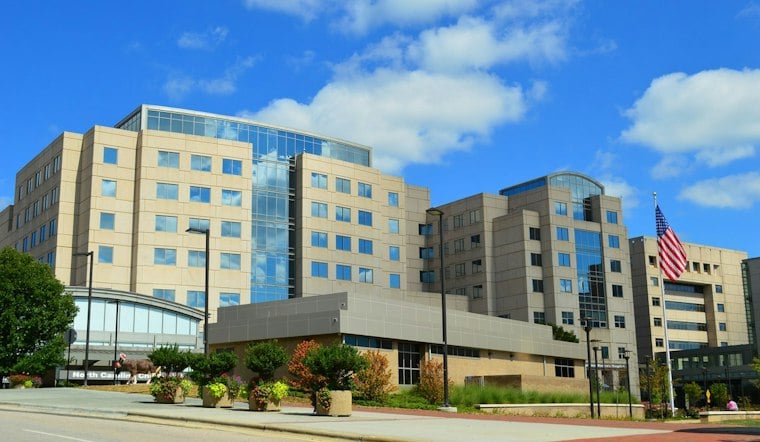
Suki is UNC Health’s first official facility dog, trained to work as a staff member in a public-facing hospital setting. At UNC Hospitals, she visits pediatric cancer patients, waiting areas and employees. Her role is part of a program that took four years to become a reality, ABC11 News reported.
The program that brought Suki to UNC Hospitals took four years to become a reality, according to ABC11 News. Suki helps patients, families and staff feel happy and calm during difficult moments, and doctors and nurses have taken to adoring her presence on the floor. Linnea Van Pelt, nurse manager for the cancer support program and a nurse for 16 years, said the program is incredible and called Suki the best part of her nursing career.
A Best Friend Named Suki
ABC11’s report focused on one of Suki’s regular visitors, John Lopez Lopez, a 12-year-old diagnosed with leukemia five months before the station’s report. His sister, Yanet Lopez Lopez, told the outlet that his diagnosis and some medications coincided with a change in his personality: he became quiet, depressed and unwilling to do things.
John told ABC11 that Suki is his best friend and that “he and Suki have each other.” He also said people begin smiling when they see her. His family told the outlet they are grateful for the bond the two have formed.
Yanet told ABC11 that John is back to being himself. Van Pelt said seeing the pair’s friendship has been meaningful for hospital staff.
Where Suki Came From
Suki came from Eyes Ears Nose & Paws, an organization based in Hillsborough, North Carolina that breeds its own dogs and teaches incarcerated men to train full-time assistance dogs through partnerships, per the same account. That training pipeline runs through a program called At Both Ends of the Leash, described by Eyes Ears Nose & Paws as a prison-based effort where incarcerated men transform puppies into skilled assistance dogs. The first At Both Ends of the Leash program started in 2014 at Franklin Correctional Center, according to North Carolina Health News, which reported that the partnership allows Eyes Ears Nose & Paws to place about 12 to 15 service dogs per year.
What the Research Says About Facility Dogs
Programs pairing dogs with pediatric patients exist elsewhere, including at St. Jude Children's Research Hospital, where St. Jude Inspire says its Paws at Play program began in 2019 in Child Life with two facility dogs and has since expanded to all Psychosocial Services with four facility dogs, each paired with two handlers. St. Jude says its facility dogs work with clinical teams to help children cope with treatment, ease anxiety and support their families.
The scientific evidence on facility-dog visits is mixed. A randomized controlled trial involving 26 pediatric oncology inpatients did not detect an effect of dog visits on patient functioning; researchers said low recruitment left the study underpowered. The trial did find lower anxiety among parents in the dog-visit group than in the control group, and found no increase in hand microbial levels when hand sanitization was used, according to the study.
Other research suggests possible benefits in narrower settings. A study indexed on PubMed Central reported evidence of decreases in patients’ self-reported pain during needlestick procedures, alongside what researchers described as a modest secondary relationship with fewer needlestick attempts. A separate qualitative study in the database recommended that future research include children’s and families’ perspectives and track outcomes over time rather than at a single point.
What the Evidence and Other Programs Show
The randomized trial described above did not detect an effect on patient functioning, though researchers noted its small sample and lower parent anxiety in the dog-visit group. A separate single-center study in Germany included 60 patients with cancer and 100 dog visits from 2018 to 2022. Its visual analogue scale data indicated higher acceptance of hospitalization when a therapy-dog visit was scheduled, according to the World Journal of Pediatrics. These findings concern those studies, not Suki specifically. As a general industry definition, Assistance Dogs International describes a facility dog as specially trained and working with a program-trained volunteer or professional; that definition does not establish Suki’s specific credentials or North Carolina legal requirements. As a separate historical example, Children’s Hospital Los Angeles says its dog-therapy program began in 2001 with three dogs visiting one 30-bed unit. That is distinct from UNC’s facility-dog program.
A Second UNC Program Still to Come
Suki's role at UNC Hospitals is distinct from a separate initiative announced for UNC Children's, called Paws & Heel, which is being supported by a donation from Carolina Hurricanes player Seth Jarvis. According to UNC Health, the health system anticipates having its first facility dog in place by mid-2027, while abc11.com reported that UNC Children's anticipates having its first two facility dogs in place by that same timeframe. The two accounts differ on how many dogs will arrive first, and it is not clear from available information why the counts differ.
Suki continues visiting the hospital, where staff say she has made a difference for patients, families and care teams.




