

























































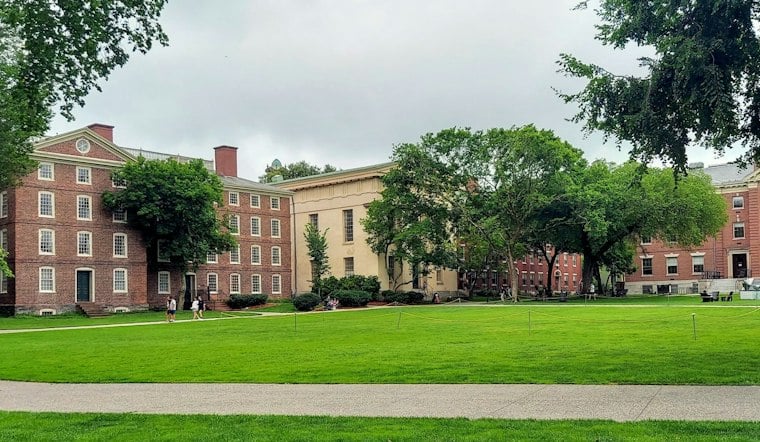
The University of Rhode Island and its fundraising foundation have gone to court seeking permission to rewrite the eligibility rules for 17 endowed scholarships that currently restrict who can win them based on race, sex or national origin. The scholarships are on hold while a Superior Court judge weighs the request, and the outcome could reshape how donor-funded aid is awarded across campus.
Two Petitions, 17 Scholarships in Limbo
According to Providence Business News, the university and the foundation filed the request asking a judge to modify the eligibility of the 17 scholarships, which currently carry restrictions tied to race, sex or national origin. Both the university and the foundation claim the donors’ restrictions may be deemed unlawful under federal law, per that same filing. One petition covers four scholarships, while a second petition, filed the same day, covers 13 scholarships that were reserved for women or gave them preference, as reported by the article.
URI spokesperson Dawn Bergantino said the affected scholarships are on hold while the petitions are being considered, the report notes. Both petitions name Rhode Island Attorney General Peter Neronha as a party, since state law requires the university to notify his office and give him a chance to weigh in, according to the same account.
Swapping Race and Gender Criteria for Need and Interest
The proposed changes replace race- and sex-based preferences with criteria like financial need, first-generation status, or interest in a particular field or culture. For one chemical engineering scholarship that currently favors women or minority candidates with financial need, URI instead wants to give preference to a first-generation student with financial need, the filing states.
A scholarship previously set aside for a woman of Arab American background would instead give preference to applicants with a demonstrated interest in studying Arab American culture, per the filing. The Day Family Scholarship, described as intended for an African American engineering student with a male preference, would be changed so it can be awarded to a first-generation full-time engineering student instead. The Mary Braga Scholarship, meanwhile, would keep its preference for Rhode Island residents while shifting toward Arts and Sciences students interested in Portuguese culture, the same report says.
Separately, the Equal Protection Project said it filed a civil-rights complaint with the U.S. Department of Education’s Office for Civil Rights over 51 URI scholarships it alleged discriminated by race or sex, according to Legal Insurrection.
Part of a Wider Shake-Up in Scholarship Rules
URI is not alone in this push. Scholarships with diversity-related eligibility criteria made up 12 percent of the National Scholarship Providers Association’s database of more than 33,000 scholarships in 2023, a share that has since dropped to about 8 percent, according to Inside Higher Ed. In Kentucky, the attorney general said multiple public postsecondary institutions have requested his office’s consent to make similar amendments to scholarships after House Bill 4 passed, the outlet reported.
That Kentucky trend has already produced courtroom action. Bellarmine University asked a judge to remove diversity criteria from four endowed scholarships, while the University of Louisville Foundation petitioned to eliminate diversity criteria from five scholarships through two separate court filings, according to LPM. A Jefferson County judge granted one University of Louisville Foundation petition but denied another, and Attorney General Russell Coleman’s office is appealing that denial, the station reported.
In Arkansas, the University of Central Arkansas said it is not opposed to modifying scholarships with race- or sex-based eligibility restrictions to appease the federal government, according to the Northwest Arkansas Democrat-Gazette. But such changes are not guaranteed to hold up: the Iowa Supreme Court ruled that the University of Iowa could not redirect a private scholarship designated for Black students toward first-generation students, finding that Black students and first-generation students aren’t interchangeable under the donor’s intent, Inside Higher Ed reported. Elsewhere, the University of Alabama discontinued its National Recognition Scholarship for minority students in 2024 and replaced it with the race-neutral UA Competitive Achievement Scholarship, the same outlet noted.
For now, URI’s 17 scholarships remain frozen as the case plays out in Superior Court, with the university and its foundation awaiting a judge’s decision on whether the proposed rewrites can move forward.





