

























































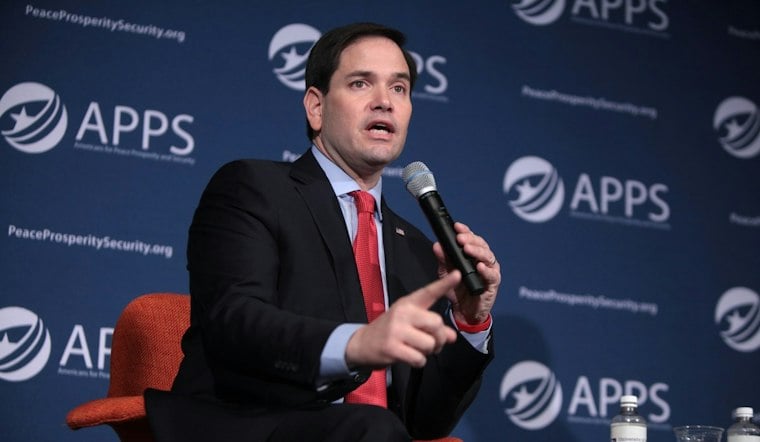
Secretary of State Marco Rubio announced Friday that the State Department designated Los Lorenzanas, a Guatemalan trafficking clan, as both a Foreign Terrorist Organization and a Specially Designated Global Terrorist. The move adds another Guatemalan criminal network to a growing roster of Latin American groups facing U.S. sanctions under designations that were traditionally reserved for groups using violence for political ends, such as Islamic State and al-Qaida.
According to Just Security, Treasury's Office of Foreign Assets Control simultaneously sanctioned two other Guatemalan organizations, Los Mendoza and Los Huistas, as Specially Designated Global Terrorists. Treasury says both groups provide logistical support to the Sinaloa Cartel and the Cartel de Jalisco Nueva Generación, and that the two groups control smuggling routes along Guatemala's borders with Mexico and Honduras.
The State Department's own release states that it is designating Los Lorenzanas as a Foreign Terrorist Organization and a Specially Designated Global Terrorist, according to the U.S. Department of State. Under section 219 of the Immigration and Nationality Act, the Secretary of State holds the authority to designate a foreign organization as an FTO, per the department's own guidance.
Part of a Broader Designation Push
Friday's action builds on designations the administration rolled out starting in February 2025, when the Sinaloa Cartel and Cartel de Jalisco Nueva Generación were named Foreign Terrorist Organizations, the same timeline documented by Just Security's reporting. As The Seattle Times reports, the Trump administration has used that broader strategy as a pretext for the capture of Nicolás Maduro and has conducted dozens of attacks on alleged narcoterrorist boats that resulted in more than 200 deaths.
Mexico has eight groups on the U.S. list, more than any other country, per the Seattle Times account, even as the U.S. government has pressured Mexico to avoid unilateral American actions on its soil. The Sinaloa Cartel, described in that reporting as Mexico's oldest criminal organization dating to the 1970s, moves drugs across continents using boats, planes, migrants and cross-border tunnels, and controls the western portion of the U.S.-Mexico border. The outlet also notes that the arrest of Ismael Zambada caused internal power jockeying that weakened the organization.
Guatemala's Most Powerful Trafficking Clan
Los Lorenzanas is a Guatemala-based criminal group and family clan accused of drug trafficking, wielding power in eastern and northern Guatemala near the Honduras border, according to the Seattle Times report. The U.S. State Department has described Los Lorenzanas as one of Guatemala's most powerful drug trafficking clans, the same reporting notes. The department designated Los Lorenzana as a Specially Designated Global Terrorist, while Treasury designated Los Huistas and Los Mendoza as Specially Designated Global Terrorists, on the same day Los Lorenzana received its Foreign Terrorist Organization designation.
The two designation types carry different consequences. A Specially Designated Global Terrorist label primarily imposes financial sanctions, while a Foreign Terrorist Organization designation carries criminal and immigration consequences, per the Seattle Times account.
A Regional Pattern of Terror Designations
Guatemala and Argentina have taken similar actions against certain criminal groups, the Seattle Times reports. Guatemala's own law, passed in October 2025, designated the Barrio 18 and Mara Salvatrucha gangs as terrorist groups and increased prison sentences for gang members convicted of crimes, according to the Associated Press. Those two gangs are based mainly in El Salvador, Guatemala and Honduras despite having originated in Los Angeles, the Seattle Times notes, and El Salvador's Nayib Bukele has imprisoned more than 80,000 people over alleged gang ties.
Argentina has designated five Latin American criminal and guerrilla groups, including Mexico's Sinaloa Cartel, as terrorist organizations, the Associated Press reported separately. Ecuador has also launched joint operations on its own soil and designated 22 criminal gangs as terrorists in 2024, according to the Seattle Times, amid gang warfare over drug-trafficking routes to the Pacific that has left hundreds of inmates killed in Ecuadorian prisons since 2021.
Cartels Reshaping Mexico's Borders and Interior
Beyond Sinaloa, the Seattle Times details how the Gulf Cartel and Northeast Cartel operate along the eastern end of Mexico, moving drugs, immigrants, guns and money, with the Northeast Cartel based in Nuevo Laredo. The Juárez Cartel has controlled Ciudad Juárez, a key Mexico-U.S. border crossing, while the Jalisco New Generation Cartel, established in the early 2010s, distributes tons of cocaine, methamphetamine and fentanyl in all 50 U.S. states, the DEA says, per that same reporting.
Local criminal groups operating in Michoacán, west-central Mexico, produce synthetic drugs and extort economic sectors including the avocado trade, according to the Seattle Times account, and La Familia Michoacana has since been renamed Nueva Familia Michoacana.
Venezuela, Haiti and the Wider Hemisphere
The designation strategy has also touched Venezuela, where the United States announced an indictment of Nicolás Maduro in 2020 and later designated Cartel de los Soles less than six weeks before Maduro's January capture, the Seattle Times reports. Venezuelans used the term Cartel de los Soles in the 1990s to describe high-ranking military officers enriched by drug-running, according to that same account. Tren de Aragua, which emerged from a prison in central Venezuela more than a decade ago, has spread from Chile to the United States and runs businesses in migrant smuggling, human trafficking, sexual exploitation and forced labor, the Seattle Times notes, against the backdrop of a Venezuelan exodus that has included about 8 million people fleeing political and economic crises.
In Haiti, Viv Ansanm launched attacks beginning in February 2024 that shut the country's main international airport and freed hundreds of inmates, forcing former Prime Minister Ariel Henry to resign, per the Seattle Times. Viv Ansanm has been reported to control about 85% of Port-au-Prince and is linked to arms trafficking; Viv Ansanm was also blamed for killing more than 70 people in Pont-Sondé in October, according to the same reporting.
Elsewhere in the region, Colombia's Clan del Golfo has an estimated 9,000 fighters and is present in about one-third of the country's 1,103 municipalities, extorting local businesses even as it has held peace talks with Colombia's government, the Seattle Times reports. In Ecuador, Los Tiguerones are among the country's criminal groups, while Brazil has urban gangs operating across the country.





