

























































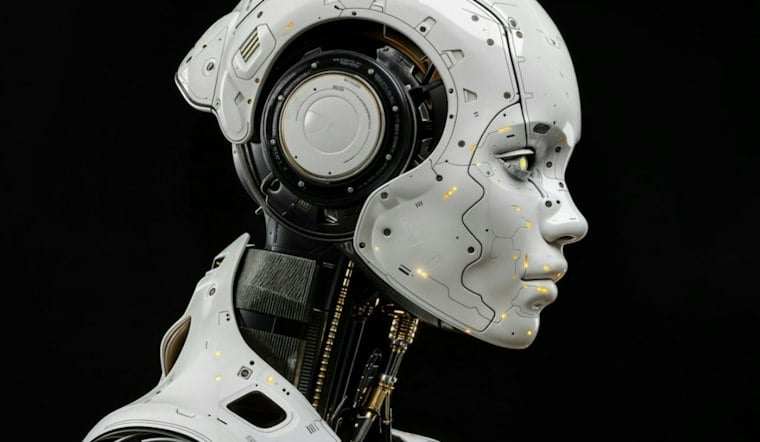
Humanoid robots could be rolling off American production lines by the hundreds of thousands within the next few years, according to a new forecast from J.P. Morgan that pegs U.S. production at 300,000 to 400,000 units by 2030, climbing to roughly 1.5 million units by 2035. The bank says the leap is being driven by labor shortages, improving economics and rising production capacity across manufacturing, logistics and warehousing.
According to channelnewsasia.com, which cited the J.P. Morgan research, the bank estimates that humanoid robot costs are now nearing parity with labor costs, and that multi-shift deployment could generate about $100,000 in annual savings per customer. That is a notable shift for an industry long associated with flashy demonstrations rather than factory-floor paychecks. The same report notes that the industry overall is moving from demonstrations to commercial deployment, a transition J.P. Morgan frames as the real story behind the production numbers.
J.P. Morgan's 2030 estimate focuses on U.S. humanoid robot production.
What's Actually Holding Humanoids Back
Despite the bullish long-range numbers, J.P. Morgan is blunt about near-term constraints. Per the bank's research, as relayed by channelnewsasia.com, humanoid deployment remains limited by hardware, AI training data, compute capacity and overall production capacity. The bank described progress as supply constrained, pointing to a handful of binding bottlenecks: hands, actuators, the onboard computing “brain,” and manufacturing capacity itself.
That bottleneck framing lines up with independent market research. IDTechEx has said that humanoid robot activity has shifted from trade-show demonstrations to structured pilots on actual production sites, a sign the technology is inching from spectacle toward operations, according to idtechex.com. The same research firm expects automotive manufacturing to be the first market segment to scale humanoid deployment at meaningful volume, with logistics and warehousing adoption following behind.
The Suppliers J.P. Morgan Is Watching
Because so much of the holdup is parts-related, J.P. Morgan has flagged component suppliers as a key near-term opportunity, favoring Timken, Robotis, Leader Drive, Orbbec and Cognex, the bank's research states. It also estimates the market for key humanoid parts — actuators, motors and vision systems — could approach $30 billion by 2035. Longer term, the bank expects value creation to shift toward the robot makers and platform integrators themselves rather than staying concentrated in parts suppliers.
Among U.S. humanoid makers, the bank's research points to Tesla's Optimus, Agility Robotics' Digit, Boston Dynamics' Atlas, Figure AI's Figure robots and Apptronik's Apollo as the companies to watch. Outside of Tesla, most U.S. manufacturers are targeting annual production in the range of 10,000 to 30,000 units, a far more modest scale than the bank's headline 2030 figure implies for the industry as a whole.
How Other Forecasters and Builders See the Market
J.P. Morgan is far from alone in trying to size this market, and not everyone agrees on the numbers. Goldman Sachs recently raised its own 2030 humanoid shipment forecast from 256,000 to 890,000 units, and lifted its 2035 forecast to roughly 6.5 million units, according to Yahoo Finance. These shipment estimates are not directly comparable with J.P. Morgan's forecast for U.S. production.
On the manufacturing side, Figure AI has said its BotQ first-generation production line will be capable of building up to 12,000 humanoids per year, with the company telling figure.ai that its supply chain could scale to 100,000 robots or 3 million actuators within four years. Morgan Stanley, meanwhile, has estimated that a humanoid robot in high-income countries cost around $200,000 in 2024, with prices expected to fall to about $150,000 by 2028 and $50,000 by 2050 as production volumes increase, according to morganstanley.com. Apptronik's Apollo robots, for their part, are already being tested in factories and warehouses run by partners including Mercedes-Benz, GXO Logistics and Jabil, per CNBC.
Trade Policy Looms Over the Supply Chain
The production forecasts arrive alongside a federal trade notice that could eventually reshape where humanoid components get built. A recent Federal Register notice states that, depending on the status or outcome of negotiations, the president may consider alternative remedies in the future — including imposing or modifying tariffs, duties, quotas and fees, or establishing a program to incentivize U.S. production. The notice frames these as conditional possibilities tied to ongoing negotiations rather than measures that have already taken effect.
For now, the industry's trajectory is being shaped less by policy than by economics and engineering. As Reuters reported alongside the J.P. Morgan figures, businesses across manufacturing and logistics are increasingly looking to automate repetitive tasks, a push that has already put at least one humanoid in the public eye — Tesla's Optimus robot appeared outside the Nasdaq market site in New York City on October 27, 2025, a glimpse of the machines J.P. Morgan says could soon be far more common on American production floors.



