

























































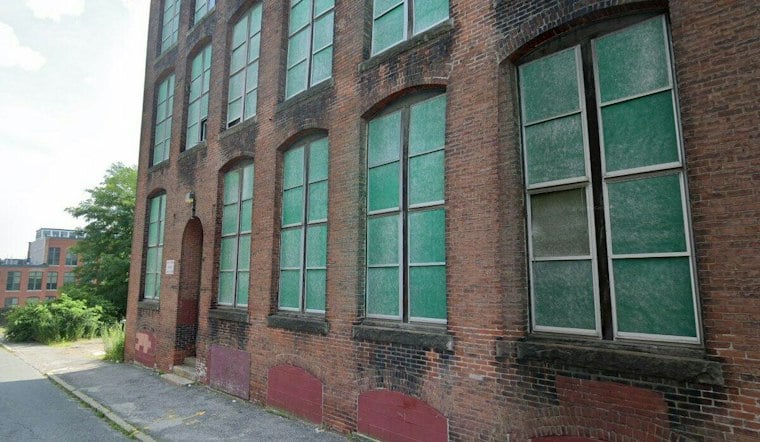
A four-story industrial building at 98 Beacon St. in Worcester's Main South neighborhood has sat empty for more than a decade. Now it's finally getting new life, with construction underway to convert the century-old structure into 58 market-rate studio and one-bedroom apartments known as Beacon Street Lofts.
The project received a $1.8 million loan from MassDevelopment, announced in a press release, according to MassLive. MassDevelopment describes itself as a development finance agency and land bank for Massachusetts that provides loans, tax-exempt bonds, grants, real estate services and other resources to businesses, nonprofits, developers, lenders and municipalities. The building itself was constructed in 1900 and sits in a neighborhood also home to Clark University and University Park.
Bluestone Residential and Civico Development LLC are the developers converting the vacant building into housing, per the same MassLive report. Beyond the MassDevelopment loan, the project also drew a $7.5 million mortgage loan from Clinton Savings Bank and $2.55 million in tax credits from the Massachusetts Historical Commission, the report states. Construction is already underway, with an estimated completion timeline of two years, according to the report.
City and Finance Officials Weigh In
Worcester City Manager Eric D. Batista said the adaptive reuse will create housing, preserve a historic building and complement neighborhood investments as it changes from manufacturing to mixed use, per the same account. Mayor Joseph Petty said converting the long-vacant historic building into 58 apartments supports Main South and the city's broader housing goals, the report notes. Eric Paley, Economic Development Secretary and chair of the MassDevelopment Board of Directors, said transforming underutilized properties into housing supports the local workforce and brings vibrancy to communities, according to the same source.
Worcester Business Journal reported in 2023 that a proposal for the same building called for redeveloping the four-story, 38,610-square-foot industrial structure into 55 market-rate and affordable units, a different unit count than the 58 apartments described in the newer MassLive report. Civico Development's own project page describes its work at the site as part of a redevelopment of the LaGrange Street Mill Complex and 98 Beacon Street into mixed-income housing, listing LIHTC and historic tax credits among its financing sources.
A Deep Housing Shortage Across Worcester
The project lands amid a well-documented affordability crunch in the city. Forty percent of all Worcester households and half of renter households are cost-burdened, meaning they spend more than 30% of their income on housing, according to the Worcester Regional Research Bureau. The bureau also found Worcester faces a deficit of more than 8,500 rental units affordable to households earning below 30% of Area Median Income, and the city is projected to need roughly 12,300 new housing units by 2033 to keep pace with population growth and existing shortages.
Part of the challenge is cost: the bureau estimated that in 2025, Worcester developers faced a roughly $241,000 financial gap in building rental units at median rents. That's one reason adaptive reuse projects like Beacon Street Lofts draw interest from developers — a 2023 report from real estate firm Matthews found that adaptive reuse projects can be up to 50% cheaper than new construction, as noted by Worcester Business Journal.
Other Mill Conversions Point to a Regional Pattern
Beacon Street Lofts isn't Worcester's first vacant industrial building turned apartments. The former Torrey Factory was converted into 47 market-rate apartments known as Torrey Factory Lofts, a project that Telegram & Gazette reported was fully leased with 31 studios, 12 one-bedroom units and four two-bedroom apartments. Cunningham Equities took a similar approach downtown, converting the former Worcester Five Cents Savings Bank at 316 Main St. into a 23-unit building with ground-floor commercial space, per Worcester Business Journal's reporting.
That same developer converted a former mill at 500 Main St. in Clinton into the 147-unit Jack's Mill in 2024, with rents reported to range from $1,950 to $2,600 per month. Farther east, WinnDevelopment's completed mill-reuse projects in Lowell have created nearly 600 units of housing in all, according to The Boston Globe. Together, the projects suggest Central Massachusetts developers increasingly see old industrial buildings as a practical answer to a housing math problem that new construction alone hasn't solved.





