

























































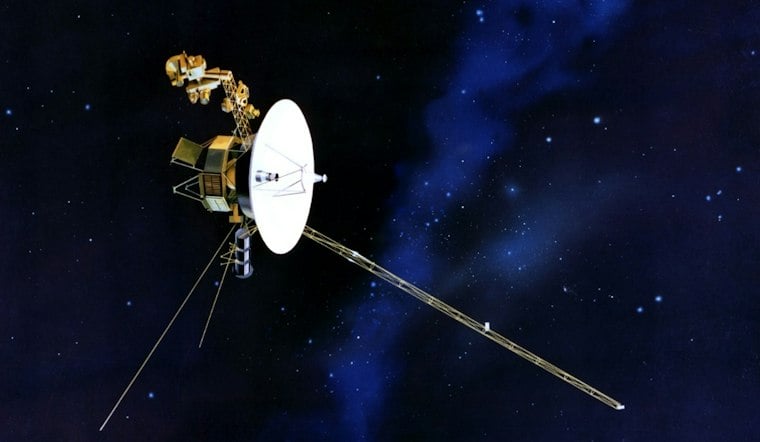
Voyager 1, the 1977-launched spacecraft now drifting through interstellar space, is about to set a distance record no human-made object has ever reached. NASA says the probe will become the first object to travel a full light-day from Earth at 4:16:07 a.m. CST on Wednesday, November 18 — a distance of roughly 16.1 billion miles, or 25.9 billion kilometers.
A Milestone 49 Years in the Making
According to EarthSky, the exact moment translates to 10:16:07 UTC, and the distance is officially defined as one light-day — the span light itself travels in 24 hours. Voyager 1 launched on September 5, 1977, swept past Jupiter and Saturn, and officially crossed the heliopause into interstellar space in 2012, EarthSky reports. It has taken the spacecraft just under half a century to put that much space between itself and home.
The scale of that distance is hard to grasp even for the mission's own team. As The Bakersfield Californian reports, citing AP aerospace writer Marcia Dunn, Voyager 1 radio signals already take about 24 hours to reach Earth, and NASA is looking at another 18,000 years before the probe reaches a full light-year. The same report notes Voyager 1 visited Jupiter and Saturn, while Voyager 2 visited Uranus and Neptune, and that both Voyager 1 and Voyager 2 continue sending back science and engineering data as they move farther from the solar system.
Voyager 2 Still Trails Far Behind
Voyager 2, launched in August 1977 from Kennedy Space Center, won't reach the same one-light-day distance anytime soon. EarthSky reports NASA has said Voyager 2 will hit that mark in November 2035, and the Bakersfield Californian's reporting on the same NASA mission also says the second probe will reach one light-day in 2035. Both accounts agree Voyager 2 is well behind its twin.
Suzanne Dodd, the Voyager project manager, is named in the Bakersfield Californian's reporting on the mission, which is housed at NASA's Jet Propulsion Laboratory in Pasadena, California. NASA has also invited the public to mark the moment: the same report notes the agency urged people to use Morse code with lights to spell out Voyager's call sign after sunset Tuesday, timed to the approach of the light-day milestone.
A Power Supply That Keeps Shrinking
The milestone comes as NASA works to keep the aging spacecraft's plutonium power supply stretched as far as possible. Both Voyager probes lose about 4 watts of power every year as their plutonium fuel depletes, according to NASA's Jet Propulsion Laboratory. To conserve energy, NASA turned off Voyager's Low-Energy Charged Particle instrument in April, per EarthSky's reporting, and the Bakersfield Californian's reporting notes NASA completed its latest round of power-conservation measures for the plutonium-powered spacecraft in September.
That power squeeze has coincided with at least one communications scare. Voyager 1 briefly lost contact with Earth in October, and NASA controllers are still trying to determine why that disruption happened, according to the Bakersfield Californian's reporting. Both Voyager spacecraft remain in communication with Earth despite the distance, EarthSky notes, though one-way messages now take approximately a day to arrive given how far the probes have traveled.
A Golden Record Still Riding Along
Each Voyager spacecraft carries a gold-plated phonograph record loaded with greetings in 55 languages, a time capsule meant for whoever — or whatever — might someday find it. Astronomer Carl Sagan included the greeting “Hello from the children on Planet Earth” on the record, according to the Bakersfield Californian's reporting, and the recording also includes the voice of Sagan's son, Nick. Nearly five decades after launch, that message is still riding along as Voyager 1 pushes past a distance no human-made object has ever reached, with NASA's own mission page describing the achievement as a matter of sheer distance — more than 16 billion miles covered in a journey of 49-plus years, according to NASA Science.



