

























































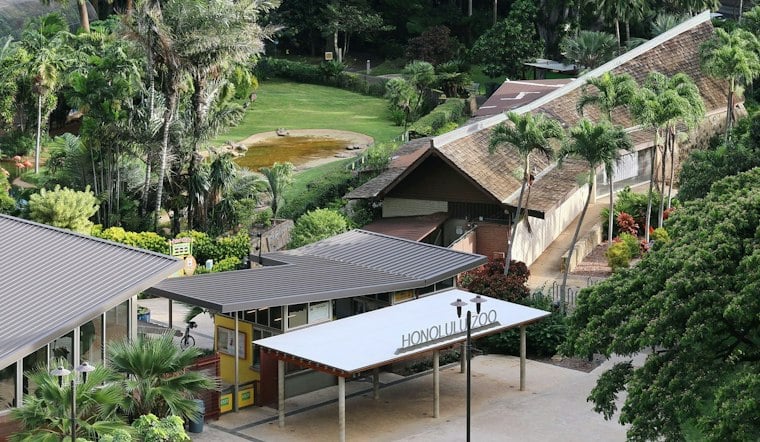
Second and fourth graders from Waikīkī School created a large-scale ceramic mosaic of a Kamehameha Butterfly, and on Nov. 5 they finally got to see it mounted on display at the Honolulu Zoo. The three-year project also involved third graders, who cut the ceramic pattern, and first graders, who glazed the pieces, before the mosaic landed in its new home steps from another student-made artwork.
Three Years in the Making
According to KHON2, the mosaic began with students painting the butterfly's wings onto sticker board before cutting out the design. Partnership and Place-Based Education Coordinator Courtney Carpenter described the timeline behind the finished piece, saying, “We've spent the last three years working on it.” The process then passed through other grade levels entirely: third graders cut the pattern out of ceramic, the pieces were fired, and first graders handled the glazing.
Carpenter explained that the finished mosaic reflects something bigger than a single art class, tying the project to the school's broader approach to place-based learning. The station's report notes that the undertaking combined art, science and environmental education, giving students a hands-on way to learn about a species found only in Hawaiʻi while also producing something permanent for zoo visitors to see.
A Butterfly Found Nowhere Else
The Kamehameha Butterfly holds a distinct place in island ecology: it is one of only two butterfly species native to Hawaiʻi, according to a University of Hawaiʻi publication. The same document notes that the butterfly was officially adopted as the state insect in 2009 after students from Pearl Ridge Elementary School proposed it to the legislature, giving the Waikīkī School project a connection to a long history of Hawaiʻi schoolchildren championing the species.
The university's materials also describe a citizen science initiative called the Pulelehua Project, which invites members of the public to report Kamehameha Butterfly sightings to help researchers map where the species still lives. That mapping effort matters because, despite occurring across all of the main Hawaiian Islands, the butterfly's range is shrinking, per the same source. A 2023 report from Spectrum News adds further detail on that decline, describing the Kamehameha Butterfly as a vulnerable species that depends on high-elevation native forests where māmaki trees grow — forests that report says are themselves shrinking.
Educational Signage Rounds Out the Exhibit
Beyond the ceramic artwork itself, Waikīkī School students also created educational signage meant to pass along what they learned to zoo visitors. Through the mosaic and its accompanying signs, the students are sharing that knowledge with the broader community, as KHON2 reported, with the project giving them a chance to explore the Kamehameha Butterfly's role in Hawaiʻi's ecosystem firsthand.
The new piece now sits beside another Waikīkī School creation at the zoo: a Koa Butterfly artwork the students made in 2022. That earlier collaboration, detailed by Kaimuki Hawaii, came about because the Honolulu Zoo already had adult-sized painted Kamehameha Butterfly wings for visitor photos and asked the school to make a child-sized set of Koa Butterfly wings to match. A 2023 Spectrum News report notes that the zoo separately breeds hundreds of Kamehameha Butterflies, underscoring the institution's ongoing role in supporting the species the new mosaic now helps explain to the public.




