

























































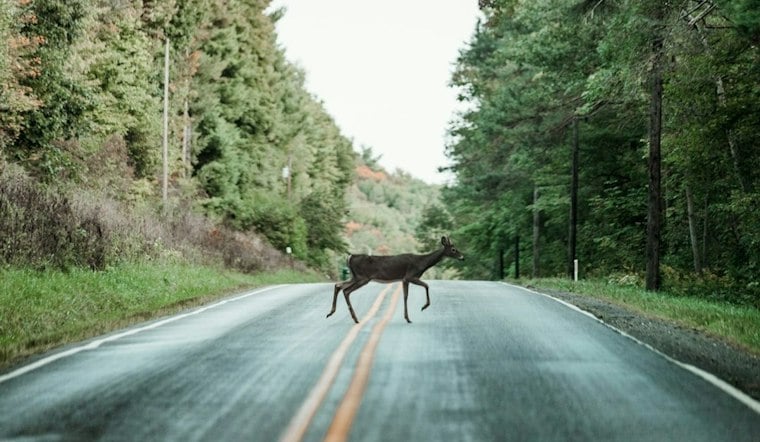
Walker city commissioners spent Monday night looking at ways to thin the local deer herd, including a possible managed cull.
The presentation came during the committee of the whole on Nov. 9, according to MLive. Jerry Byrne, managing director of the Kent County Road Commission and a representative of the Kent County Deer Management Coalition, told commissioners the problem is both on the roads and in the yards.
Crashes, Browse and Regular Complaints
Byrne said Walker currently has the highest rate of vehicle-deer crashes in Kent County.
Separate state crash tables do put numbers on the collisions themselves. Michigan Traffic Crash Facts recorded 1,960 deer-involved motor vehicle crashes in Kent County in 2025.
The damage is not only metal and glass. Byrne said Walker's green spaces show significant deer browse, with some areas left looking like a desert and very little vegetation remaining. The browse line, he told commissioners, reaches as high as the deer can reach. Residents have reported deer eating ornamental plants, flowers, juniper trees and lawns, and leaving droppings in yards and driveways. Commissioners said they hear similar complaints regularly and that the issue has lasted for years.
Little Land for Ordinary Hunting
Traditional hunting is a thin tool inside the city limits. The coalition's presentation described only about 4,400 acres, or 11% of Walker's land, as available for traditional hunting methods, limiting the areas suitable for that approach.
The alternative described Monday is a wildlife damage nuisance control permit from the Michigan Department of Natural Resources, issued directly to the city. If Walker pursued that path, the permits would allow managed culls. Coalition staff offered to walk the city through an application.
State law does leave room for that kind of permit. Under MCL 324.40114, the department may authorize the taking of animals to prevent or control damage to crops or feed, disease, or nuisance. The statute does not decide whether Walker qualifies, or on what terms a cull would run.
Who Would Shoot, and What It Would Cost
If permits were in hand, the presentation laid out three operators: the U.S. Department of Agriculture, local law enforcement, or a private pest-control firm. The coalition's recommendation is local officers, on the argument that residents generally trust them more and that police can schedule the work with more flexibility than an outside crew.
The meat cannot simply be discarded. Any deer taken in a managed cull must be processed for human consumption. Walker's estimated processing cost is about $200 per deer. Sending the shooting itself to the USDA or a private firm was estimated at $400 to $500 per deer on top of that processing fee. A city-run operation using local officers would still carry the processing bill.
Those figures are estimates attached to options, not a budget the commission adopted. Commissioners heard the menu. They did not order from it.
A County Effort Already in Motion
The coalition has spent nearly three years on countywide deer management. Its roster includes six cities, Kent County, the Kent County Road Commission, the Michigan Department of Transportation and 21 townships. Byrne has described the work as a standing problem of herd health, public health and nuisance, and told WOOD-TV, "It's going to continue year after year after year."
Grand Valley State University researchers have surveyed deer in Walker and Grand Rapids as part of the coalition's effort to assess the county population, GVSU reported. Older crash shares are also in circulation, and they do not describe the same slice of the county. The coalition has said deer-related incidents made up 26% of all vehicle crashes in Kent County townships in 2023. In August, Byrne told Michigan Public that 25% of crashes in Kent County were deer-related. One figure is township crashes in a named year; the other is a broader county statement. They are not interchangeable.
Alongside any talk of culls, the coalition has tried to move meat and hunters rather than only carcasses. In 2026 it worked with the DNR and the National Deer Association to launch Deer Connections, an app linking landowners, hunters and venison donation recipients. It also facilitated crop-damage permits. More than 160 deer were harvested on Kent County farms under those permits, with 50 donated and processed through a DNR partnership with the coalition. Separately, the coalition donated 1,000 pounds of venison to a veterans' food pantry in Grand Rapids.
The Road Commission has its own matching project for hunters and large property owners. About 50 hunters signed up immediately. Landowners have been harder to recruit. That split matters in a city where only 11% of the land is already open to traditional hunting: willing shooters are not the scarce piece.
Other Cities, and 2027
Michigan suburbs that have already tried sharpshooters have not found a clean municipal product. Ann Arbor killed nearly 500 deer in annual culls from January 2016 to January 2020, and a later account said the culls noticeably reduced the population before the program ended. The city also surgically sterilized dozens of deer. MLive's Ann Arbor reporting put the cost in the hundreds of thousands of dollars and noted protests and legal action. Deer management is back on that city's agenda.
The coalition's 2027 list is less dramatic than a cull and more about access: expand the municipal permit program, keep urban archery going where properties are available, and work with Kent County Parks to open more parkland for hunting. A city-issued nuisance permit was one option presented to Walker.





