

























































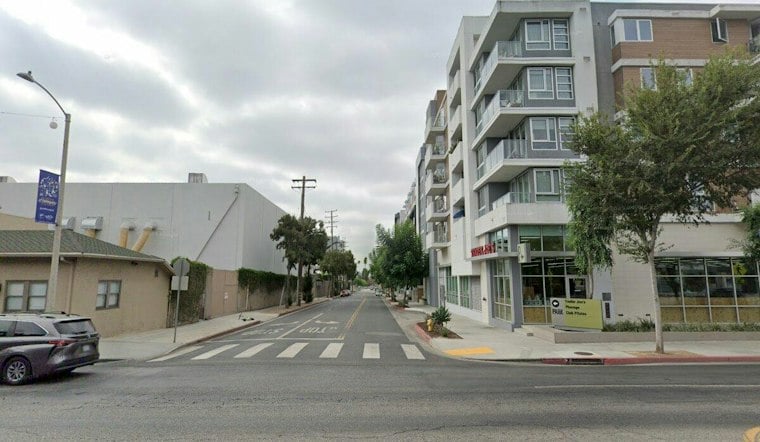
West Hollywood's City Council voted 5-0 Tuesday night to require future city-assisted senior and disability housing projects to include at least two elevators or an equivalent backup access system, a move prompted by ongoing problems at Movietown Square, the Santa Monica Boulevard senior building where a single elevator has repeatedly left wheelchair users stranded in their own apartments. The new rule will be written into loan paperwork for qualifying projects, but it does nothing to change the elevator situation at Movietown Square itself, where residents have been living with the vulnerability for years.
According to WEHOonline.com, Movietown Square is a six-story, 77-unit senior building at 7302 Santa Monica Boulevard that has just one elevator serving the entire property. A 2024 cabling replacement substantially cut down on outages, staff told the council, but the building still has no backup: when the elevator goes out, even briefly, residents who use wheelchairs are stuck in their apartments with no way down. A separate report from the Beverly Press & Park Labrea News described the complex differently, putting the total unit count at 371, including 77 units designated as affordable senior housing, and reporting that a single elevator facilitates access to the affordable housing units.
Alicen Bartle, the city's project development administrator, presented the staff report alongside building and safety staff, laying out the problem the council has now spent more than a year chewing over. Staff called the single elevator a vulnerability whenever it needs maintenance. Beverly Press reported in March 2025 that the council had addressed Movietown Square safety and accessibility complaints and that staff would return with recommendations at a later date — recommendations that finally reached the dais this week.
Residents Say Eight Years Is Too Long to Wait
The new requirement applies going forward only to projects with 40 or more units or four or more stories, and it comes paired with an exceptions process: a project could skip the second elevator if it offers a backup access measure instead, such as guaranteed maintenance response times or a platform lift, with any such exception going to the City Council for information only. City staff recommended amending affordable housing loan commitment letters and loan agreements to lock in the standard, but the report is explicit that there's no timeline for any of it taking effect.
That gap between policy and practice did not sit well with everyone in the room. Victor Omelczenko told the council residents cannot wait another eight years while single-elevator failures strand vulnerable seniors, a pointed reference to the building code freeze now standing between Movietown Square and a mandated fix. Under Assembly Bill 130, which the report says freezes residential building standards from October 1, 2025 through June 1, 2031, a building code amendment requiring a second elevator is off the table until then.
Councilmember Lauren Meister pushed back against that timeline, asking staff and the city's lobbyists to press Sacramento on the state rules; her request was folded into the motion the council ultimately approved. It's a signal that West Hollywood officials see the state freeze as an obstacle worth lobbying against, even as the local loan requirement moves forward on its own track.
Security Gaps and a Costly Retrofit Debate
Beyond the elevator itself, the Movietown Square report flagged a second access problem: a fire door connecting the building's interior stairwell to the parking garage for the Trader Joe's next door. Fire code requires that door to allow people to exit at all times, which means it cannot be locked in a way that keeps residents in — but that same requirement has, on occasion, let unauthorized people into the stairwell. The building's owner and operator, the West Hollywood Community Housing Corporation, has installed 24/7 monitored cameras near the door, which staff called a good temporary fix, and the organization is now looking at adding a security door. The city said it would offer technical help finding a code-compliant door that supports both egress and security. Staff reported finding no other building issues requiring immediate city attention.
On the elevator itself, staff recommended exploring a retrofit — either a secondary lift or a platform lift — in partnership with the housing corporation, with the city potentially weighing in on funding. The price tags attached to that kind of fix explain why it hasn't happened yet. Adding a second elevator to a brand-new building typically runs $175,000 to $275,000 for a five- to six-story senior project with 60 to 80 units, representing roughly 0.5 to 1 percent of hard construction costs. Retrofitting one into an existing building like Movietown Square is a different matter entirely, with costs that can run from $500,000 to more than $1 million. A second elevator also eats up 60 to 100 square feet on every floor, meaning a project could lose one to three units or parking spaces just to make room for it.
A Site With a Long, Winding History
The site has been through its share of upheaval before. The development that includes Movietown Square broke ground in 2014, but the land it sits on was once home to Movietown Plaza, a strip that housed the Yukon Mining Company, Bombay Grill and West Hollywood's first Trader Joe's. Tenants there were told to leave in 2010, and Trader Joe's held on at the old plaza until 2013 before the grocer eventually returned to the redeveloped site in 2017.
For now, the two-elevator requirement stands as a forward-looking fix rather than a remedy for the building that exposed the problem in the first place. Future senior and disability housing projects built with city assistance will have to plan for redundancy from day one, but the residents of the 77 affordable units at Movietown Square who rely on that single elevator are left watching a state-level freeze and an undetermined retrofit timeline, with no firm date for when — or whether — a second way up and down is actually coming.




