

























































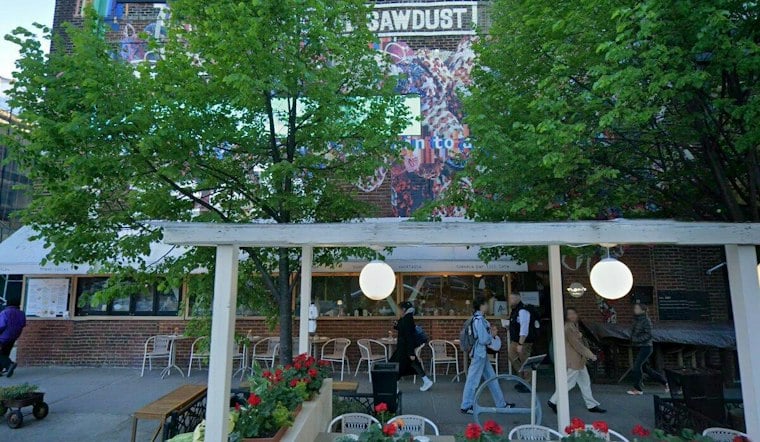
A Deaf innkeeper who lost her hearing to a meningitis outbreak 25 years earlier takes center stage in a reimagined version of Vincenzo Bellini's bel canto classic La Sonnambula, landing at National Sawdust in Williamsburg on November 18. The 90-minute concert production, staged by Opera Praktikos, folds American Sign Language directly into the opera's storytelling rather than treating it as a separate interpretation layered on top of the singing.
Opera Praktikos will present La Sonnambula, or The Sleepwalker, as part of National Sawdust's inaugural makemake Festival, according to Brooklyn Paper. In this version, ASL is woven directly into the storytelling rather than used as an interpretation of what happens onstage, the outlet reports. The character of Lisa, the proprietor of a local inn, is reimagined as Deaf after surviving a meningitis outbreak that swept through her Swiss Alpine village a quarter-century before the opera's events, per the same account.
Lisa is left orphaned by the outbreak and lives and works alongside her aunt Teresa, who later adopts Amina, a poor orphan preparing to marry Elvino — Amina's sleepwalking remains the heart of the opera's central plot, the Brooklyn Paper account notes. What sets this production apart is that Lisa communicates entirely through ASL, with no hearing performer standing beside her to interpret her signing for the audience. In some arias, she signs the same words another character is singing at the same moment, allowing the two languages to unfold side by side.
A Co-Founder's Vision Rooted in Disability and Community
Opera Praktikos co-founder and executive producer Marianna Mott-Newirth has described ASL as an expressive language with operatic qualities that could enhance the production, according to the outlet's report. Fellow co-founder Greg Moomjy, an opera journalist and musicologist who uses a wheelchair and has cerebral palsy, saw in the story an opportunity to explore disability and how communities respond to people they do not understand, the article states. The production team developed Lisa's backstory around a historical meningitis outbreak in Geneva, Switzerland, drawing on the fact that meningitis can cause hearing loss — a detail also reflected in another character, Edmond, who is deaf due to meningitis in the reimagined narrative.
The company's path to this production began gradually. Opera Praktikos first experimented with combining ASL and opera in 2023, when it brought in a Deaf performer to shadow a singer during a single aria, the Brooklyn Paper reports. That early test evolved into something more ambitious this year: Mott-Newirth contacted Brandon Kazen-Maddox of Up Until Now Collective, who had previously incorporated ASL into opera performances, and the two organizations held a workshop in June where singers and Deaf performers began exploring how their respective languages could work together.
Rehearsal Room Breakthroughs and a Condensed Score
During rehearsals, moments emerged that crystallized the approach — in one instance, singer Philip Bullock sang to a character while performer Mia Sanchez responded entirely in ASL, according to the outlet's account. To fit the sprawling bel canto work into a single evening, composer and arranger Spicer Carr condensed Bellini's original three-hour opera into a 90-minute performance and arranged the music for an eight-piece orchestra. The production team also had to coordinate the timing of musical and ASL performances so the two languages could move together rather than compete for the audience's attention.
Mott-Newirth has urged audiences to experience Lisa's signing without worrying about understanding every word, the Brooklyn Paper notes. A separate account from Unscripted Arts describes the production's layered language structure plainly: it's sung in Italian, signed in ASL, with English supertitles for the audience.
From a Lower East Side Garden to a Williamsburg Stage
Mott-Newirth and Moomjy met at an Opera America symposium in 2018, and Moomjy had long dreamed of running his own opera company, per the Brooklyn Paper's reporting. Opera Praktikos produced its first show, George Frideric Handel's Orlando, in a Lower East Side community garden in 2021 — and Moomjy required that the company's debut be accessible to people with disabilities, including wheelchair users. That same community garden production, staged at Campos Community Garden, offered flexible seating and an accessible portable restroom, and the performances were free, according to HowlRound Theatre Commons, which also quotes the company's mission to bring artists with disabilities and artists without disabilities together to make opera accessible for audiences and performers alike.
Opera Praktikos describes itself as an inter-abled organization, with disabled and nondisabled people working both onstage and behind the scenes, the Brooklyn Paper reports. Mott-Newirth, who spent much of her young adult life in Park Slope, has pointed to National Sawdust's reputation for experimenting with traditional art forms and exploring new approaches to music as part of why the venue felt right for this production. Separately, National Sawdust describes the company, formed in 2022, as a disability-affirmative organization presenting a genre of opera that is interabled.
What Comes After the Concert Version
Opera Praktikos plans to develop a fully staged production after learning from how the orchestral concert plays out. Here the available sourcing diverges: the Brooklyn Paper reports the company is targeting January 28, 2027, for that fully staged version, while Opera Praktikos's own website lists the fully staged production for November 2027. Both dates come from credible sourcing, but they do not match, and neither can be confirmed as final from the material available.
Opera Praktikos is not alone in bringing ASL into opera houses. Lyric Opera of Chicago said its own ASL-interpreted performance of Don Giovanni marked a first for an opera in another language at that company, according to ABC7 Chicago, which reported that interpreters there created their own translation combining the sung material with physical interpretation of the orchestra's sound. The group SIGN & SING has taken a related approach elsewhere, describing its method as performing ASL, voice, and piano simultaneously and with equal value, per OperaWire.
The Williamsburg performance begins at 7:30 p.m. on November 18 at National Sawdust, located at 80 N. Sixth St., according to the event listing. A free pre-show panel on ASL in the arts is scheduled for 7 p.m. that same evening at the venue, and tickets for La Sonnambula are available through National Sawdust.





