

























































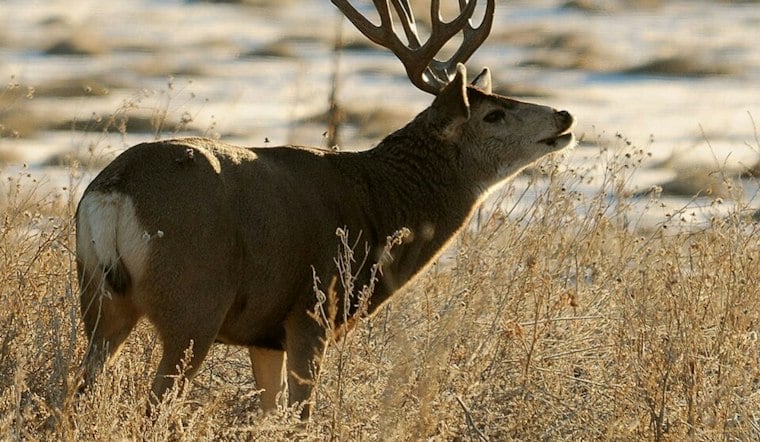
Every spring, mule deer across western Wyoming rise out of the Red Desert and begin one of the longest land migrations in the lower 48 states, some traveling as far as 150 miles to reach summer range in the mountains. The journey is ancient, but it is increasingly a race against fences, highways, and subdivisions that did not exist when these routes were first carved out thousands of years ago.
The scale of that migration came into sharper focus through new tracking data described in a report from KOSU, which detailed how one mule deer herd spends summers in the mountains south of Grand Teton National Park before migrating south in winter to Wyoming's Red Desert, where deep snow makes it impossible for the animals to stay in the high country and food in the desert itself is scarce. Matt Kauffman, a wildlife biologist with the U.S. Geological Survey and the University of Wyoming, and colleagues tracked roughly 100 mule deer during spring migrations using GPS collars, including one deer that covered more than 240 miles one way, according to the same report. Kauffman described the work as part of the Wyoming Migration Initiative, a multi-year University of Wyoming project, telling the outlet that mapping migrations and finding tools to keep landscapes open amounts to a race against change.
Separate research examined 99 adult female mule deer migrating north along the Wyoming Range, fitted with GPS collars that logged locations every one to five hours. According to the Wildlife Management Institute, all of the tracked deer showed evidence of following the spring green wave of emerging vegetation, and roughly one third matched their movements closely to the timing of green-up. The deer tracked that green wave more successfully on routes where green-up lasted longer, progressed faster, and moved consecutively from winter range to summer range, the Institute reported. The study's lead author said management decisions and future research need to account for how habitat along migration corridors shapes movement and foraging.
Why Deer Chase the Green Wave
Mule deer follow spring green-up because young plants and grasses are protein-rich and low in fiber, letting the animals build the fat reserves they need before winter returns, per KOSU's reporting. Climate warming is testing the timing of that migration, and drought years can make the green wave shorter or more patchy, forcing deer to adapt to shifting conditions. The same report noted that mule deer tend to move in small groups rather than large herds, and that their migration timing is built around reaching summer feeding grounds while avoiding harsh winter weather.
Development along migration routes complicates that calculus. KOSU's report described a bottleneck near Pinedale where roughly 5,000 mule deer must pass between buildings and fences each season, and noted that deer often hesitate at developed areas before rushing through them, a behavior that makes it harder for the animals to stay synced with green-up. Fences themselves can slow or kill wildlife, and development more broadly constricts migration routes and reduces the flexibility deer need as the climate shifts, the outlet reported, citing Arthur Middleton, a professor of wildlife management at UC Berkeley, who said development is pushing some migrations toward a crisis point.
Wyoming's Population Numbers Tell a Stark Story
The declines are not abstract. Wyoming's statewide mule deer population stood at more than 500,000 in 1990 and is now about half that number, according to KOSU's reporting. A separate rangewide assessment from the Western Association of Fish and Wildlife Agencies found mule deer and black-tailed deer populations declining in 12 of the 24 member jurisdictions it tracks over a three-year span.
The Wyoming Range herd specifically has its own troubled arc. Nearly 60,000 deer were counted there in 1991, with a projection of 25,000 by 1993, according to the Wyoming Wildlife Federation. Today the Wyoming Game and Fish Department estimates around 30,000 deer in that population, still well below the 40,000 objective set in 2016. A severe winter in 2022-2023 caused thousands of deer deaths across the state, KOSU reported, underscoring how quickly conditions in the Red Desert and surrounding range can turn deadly.
Fences, Collisions, and a Patchwork of Protections
Wildlife-friendly fences, which use a smooth bottom wire with space for animals to pass beneath and closely spaced top wires that cut the risk of deer getting caught, are one of the main tools being deployed. Converting a mile of fence costs around $25,000, and a state and federal program helps offset that cost for landowners, according to KOSU's report. Wyoming has converted more than 900 miles of fence so far, per the same reporting, while Jill Randall, big game migration coordinator with the Wyoming Game and Fish Department, has worked on that effort statewide. Wildlife collisions are documented roughly 7,600 times a year in Wyoming, and mule deer are hit by vehicles more often than any other species in the state, KOSU reported.
Wyoming has designated four migratory corridors in total, protecting one pronghorn route and three mule deer routes by restricting development in the most tightly constricted sections, according to the outlet's reporting. Development is prohibited outright in those pinch-point areas but allowed elsewhere along the corridors after consultation with wildlife officials. Those rules do not apply on private property, where conservation work remains voluntary and left to individual landowners, KOSU noted. Conservation groups sued the Trump administration this year to overturn an oil and gas lease sale near migratory corridors, the outlet also reported.
One Ranch's 27-Year Commitment
Maggie Miller has run Grindstone Cattle Company for 27 years, land that has been in her husband's family since the 1800s, according to KOSU. Miller protected part of that ranchland from future development by selling development rights over 19,000 acres, alongside a nearby ranch, to the Wyoming Stock Growers Land Trust — an easement that prevents development on that acreage even if the land is later sold. Tri-State Livestock News reported that the conservation easement project, encompassing 17,000 of Grindstone's acres within the larger 19,000-acre deal, was completed in 2012.
Miller's advocacy extends well beyond her own fence lines. She has served as an advocate for landowners and agricultural interests within the Sublette Mule Deer Migration Corridor, the outlet reported, and in 2008 she partnered with a neighbor on the first fence-conversion project the Natural Resources Conservation Service carried out in Sublette County. More than 33 miles of fence on Grindstone Cattle Company have since been converted to wildlife-friendly standards, part of a broader total exceeding 750 miles converted across the region, per the same report. That record of work recently earned Miller recognition as the 2026 recipient of the Kurt Bucholz Conservation Award.
Landowners and conservation groups working together to preserve open lands and working ranches remain central to keeping migration routes intact, KOSU reported, even as the pace of fencing, roads, and subdivisions continues to test how much habitat the deer have left to work with. Wyoming's migratory wildlife are on the decline overall, and researchers like Kauffman have framed the broader effort — mapping routes, converting fences, and negotiating with landowners — as work that still needs more resources to keep up with the speed of change on the landscape.



