

























































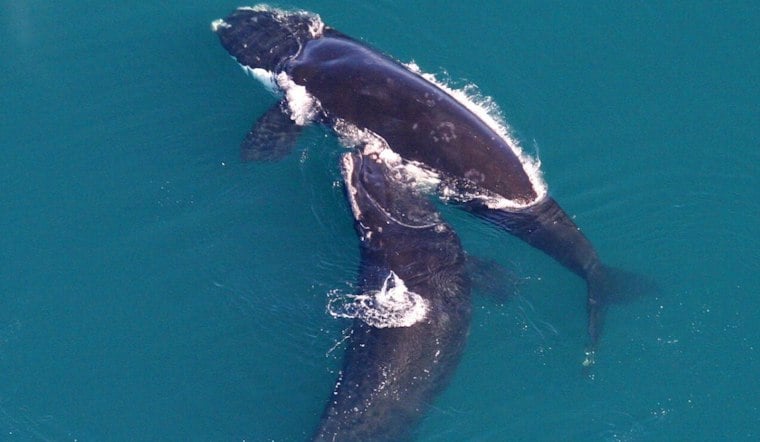
A one-year-old North Atlantic right whale known as #5042 was satellite-tagged off the Virginia/North Carolina coast in March 2021, and federal wildlife officials have used her tracked path to illustrate just how much commercial vessel traffic swims alongside these endangered animals as they migrate along the East Coast. Right whales, one of the rarest large whale species on the planet, remain endangered decades after commercial whaling nearly wiped them out, and the dangers they now face come almost entirely from modern shipping lanes and fishing gear rather than harpoons.
Tracking a Young Whale Through Crowded Waters
According to NOAA Fisheries, the agency has displayed the migratory path of whale #5042 to show how young right whales travel through some of the busiest commercial shipping corridors on the East Coast, a route that has previously taken whales north along the New Jersey and New York coastline. NOAA Fisheries also points to entanglements and vessel strikes as leading causes of serious injury and death for right whales, a danger that persists even though the species has been under federal protection for decades.
Those two threats were on full display in 2024, a year that saw five right whale deaths, 16 entanglements, and eight vessel strikes, according to a report from the New England Aquarium. Ten of those entanglements involved whales caught with attached fishing gear still on their bodies, the aquarium's report notes. So far in 2025, researchers tracking the population have logged no deaths, one new entanglement injury without attached gear, and one vessel strike, the same report states.
A Population Still Struggling to Recover
The aquarium's October 2025 update estimated the North Atlantic right whale population at 384 animals in 2024, with a margin of error of plus 10 or minus 9, representing a 2.1 percent increase from a recalculated 2023 estimate of 376. There was a bright spot in the data too: eleven calves were born during the 2025 calving season, including four born to first-time mothers, the aquarium reported. Even so, the species remains far from the numbers it once had before commercial whaling drove it toward extinction, and officials continue to treat vessel strikes and entanglements as the main obstacles standing in the way of recovery.
Spotting a right whale from the deck of a ship is harder than it sounds. The animals frequently swim at the ocean's surface, but their dark bodies and lack of dorsal fins make them tough for boat operators to see, especially in rough seas, bad weather, or at twilight — conditions that are common along the busy Atlantic seaboard during migration season.
Most Ships Ignored Speed Limits, Oceana Found
Federal regulations require most vessels 65 feet or longer to travel no faster than 10 knots, or roughly 11.5 mph, inside designated Seasonal Management Areas along the East Coast. But an analysis from Oceana, which examined Automatic Identification System data from vessels 65 feet and longer between November 2020 and July 2022, found that 84 percent of vessels exceeded the speed limit across all Seasonal Management Areas during both of its study seasons.
The numbers were just as stark in the waters right whale #5042 would have crossed on her way north. In the Seasonal Management Area covering the ports of New York and New Jersey, the same analysis found 85.4 percent of vessels exceeded the speed limit during the November 2020 to July 2021 season, and 87.1 percent did so the following season. Even in voluntary slow zones, where compliance is not legally mandatory, Oceana's data showed 82 percent of vessels ignored the recommended 10-knot speed limit during the same period.
Those voluntary zones have been part of the conservation toolkit for years. Back in November 2020, NOAA Fisheries announced that a voluntary Slow Zone southeast of New York City would remain in effect through December 15 that year, one of several seasonal measures the agency has used to try to reduce the odds of a deadly collision. Mandatory speed restrictions near the entrances to New York and New Jersey ports run every year from November 1 through April 30, according to NOAA's speed zone dashboard.
What the Law Requires Near a Right Whale
Beyond speed limits, federal and state law also prohibits vessels from approaching a right whale closer than 500 yards, according to a NOAA Fisheries bulletin. That buffer is meant to give the animals space in waters where they already face long odds simply trying to be seen. As reported by the New York Post, the tagged journey of whale #5042 has become a vivid illustration of just how much ship traffic a single young right whale must navigate on a single migration north.





