
























































As we all await the reopening of the building at the southeast corner of Haight and Fillmore, let's travel back in time to discover a story from its past.
In a new series we're calling "Time Machine," we're digging up old news articles from the neighborhood's distant past. Today we actually have two stories about a barbershop at 495 Haight Street, run by two consecutive owners with a penchant for wealthy widows. The first story was originally published in the San Francisco Chronicle on October 10, 1891.
Less than a year later, on July 23, 1892, the Chronicle published a follow-up story, detailing a very different outcome.
In a new series we're calling "Time Machine," we're digging up old news articles from the neighborhood's distant past. Today we actually have two stories about a barbershop at 495 Haight Street, run by two consecutive owners with a penchant for wealthy widows. The first story was originally published in the San Francisco Chronicle on October 10, 1891.
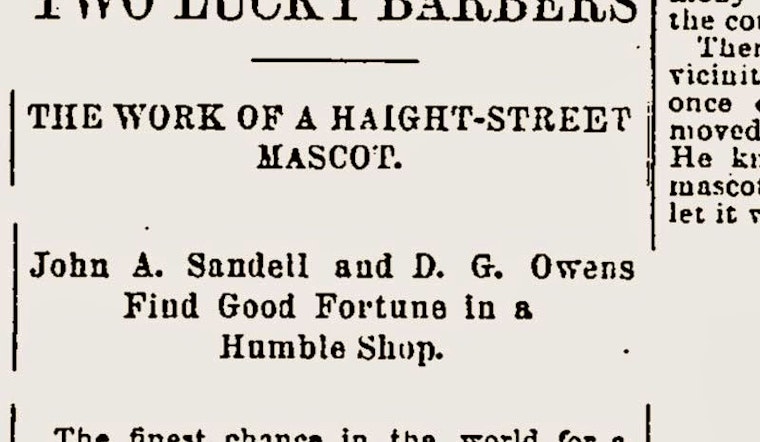
TWO LUCKY BARBERS
THE WORK OF A HAIGHT-STREET MASCOT
John A. Sandell and D. G. Owens Find Good Fortune in a Humble Shop.
The finest chance in the world for a young man who wants money without toiling and saving for it will be open in a few days when a "To Let" sign is posted in the window of 495 Haight Street.
The place is a humble little one-story building with a striped pole in front of it. There isn't anything about it to indicate what a really wonderful place it is, but just the same all the neighborhood is gossiping about it and trying to figure out why and how it is that it is so lucky.
The little barber shop hasn't a great deal of good-will to go with it. The stock could be bought for a few dollars and the fixtures are limited and inexpensive, but among the appuriences is a mascot -- a real giver of good fortune -- that is worth to the favored one the price of a score of small barber shops.
About six months ago John A. Sandell was eking out a precarious existence by scraping the chins of Western-Additioners in the little shop. Mrs. Bomheimer, a widow with $50,000 in houses and lands between her and destitution, lived at the corner of Haight and Fillmore streets. Her eyes rested approvingly on the young barber, and despite the fact that she had lived a full half century longer than he had they married.
The name Sandell is not unfamiliar to the public, for the erstwhile widow is now resisting in the Probate Court the attempt of her married daughters to have a guardian appointed to take care of her property.
Once married, Sandell had no more use for the little barber shop, so he sold it, good will, mascot and all, to D. G. Owens, another young and impecunious knight of the strop and razor.
The mascot worked like a charm. Barber Owens has won the hand and heart of another $50,000 widow and lives in blissful expectancy of leading her to the altar. The disparity in years is not so great in this case, but it is a fact that the fiancee of the blissful barber is a dozen and more years the senior of her prospective lord and master. Her name is Mrs. Harriet E. Olsen and her dear departed, whom she will soon replace, left her two flat houses at 10 and 10 1/2 Webster street and a good interest in two coasting schooners, besides a comfortable bank account. The ceremony will take place in a few days and the couple will live at 10 Webster street.
There is only one unhappy person in the vicinity, and that is D. G. O'Neil, who once occupied 495 Haight street, but moved after a brief stay to the next block. He knew nothing about the rich-widow mascot and did not stay long enough to let it work its charm.
Less than a year later, on July 23, 1892, the Chronicle published a follow-up story, detailing a very different outcome.
OLD DAMES' DUCATS
Unhappy Unions of May and December
The Martial Experiences of Two Barbers.
Consecutive Tenants of the Same Shop and Tinged With the Same Fate
---------
To the minds of many residents in the neighborhood of Haight and Fillmore streets the barber shop at 495 Haight street possesses a peculiar interest. Last year it was looked upon as the lucky number of the neighborhood, but this year it seems to have a halo of "hoodoo" about it. Its reputation for good luck grew out of the fact that two successive tenants of the shop each married a wealthy widow, but a blight has fallen upon their quondam habitation because both marriages have proved unhappy and have resulted in divorce.
The first of these two barbers to catch a rich wife was John A. Sandell, a young fellow only 25 years of age, whose bride, wedded now just a year ago, was Mrs. Katherine Bomheimer. Her silver hairs, 75 years, and grandchildren were balanced by her possession of about $50,000 in gold. The wedding created a sensation and the honeymoon was the talk of that portion of the town. The aged widow had been a recluse, but when she became a bride she blossomed out in silks and satins and took daily airing in the park in a neat phaeton with her young husband by her side.
But the young husband found that "love unchanged will cloy." Time began to grow heavy on his hands. He pined for this razors again, and opened a shop in the basement of his wife's house at 458 Haight street just to have something to do, he said. Gradually the young husband and his bride of 75 summers drifted apart. She saw that she was not making a success of connubiality, and took the first step to rid the young man of his incumbrance. She instituted snit for divorce, and Sandell, chivalrous to the last, did not oppose her motion. Thus was the knot cut, and that chapter was ended.
Meanwhile Sandell's old shop at 495 Haight street had come into the possession of Robert Owens. He, too, was young, and altogether comely. His customers used to joke him about having such a lucky shop, but they opened their eyes with astonishment when he emphasized the luck of the establishment by so closely following the example of his predecessor as to marry Mrs. Harriet E. Olsen, who, whole not quite as old as Sandell's bride had been, was rich enough to keep up the record of the shop. This wedding took place on the 26th of last November. She was the widow of a thrifty captain of a coasting schooner who left their three daughters several lots in the suburbs, and made the widow more than comfortable with an eighth interest in the schooner San Buenaventura and money enough to build a two-story flat house at 10 and 10 1/2 Webster street, to say nothing of a bank account.
Into this flat moved Barber Owens, and his wedded life with the ex-widow began. According to her story it was not devoid of interest. She was not a woman of the world, and she had great confidence in her young husband at first. Even before they were married, she says, he secured a power of attorney from her while she was ill, ostensibly to sell her share of the Buenaventura. This he did for $650, he claimed, but Mrs. Owens says it was worth much more. Furthermore, she says, he put her home property on the market, and she did not know it until after they were married and some parties came to look at the house.
This discovery caused Mrs. Owens to lose faith in her young husband. She tried in vain to get back the power of attorney, and was finally forced to put all her property out of her hands to prevent him from converting it into cash. As soon as Owens learned of this, she says, he began the course of brutal treatment which she made the basis for her suit for divorce. She claims that she had to lock him out of the house as a matter of self-preservation. The first night she did this he rang the bells and pounded so hard that she opened the door. Owens came in, seized her, threw her on the floor, and only desisted when the neighbors came to her rescue. He then went to his barbershop and spend the night in a chair. All this and much more did Mrs. Owens set forth in her petition, and the neighbors declared it was a just decision when Judge Troutt a few days ago granted her a divorce on the ground of extreme cruelty. Owens still runs the shop on Haight street, but the horseshoe no longer hangs over the doorway.





