

























































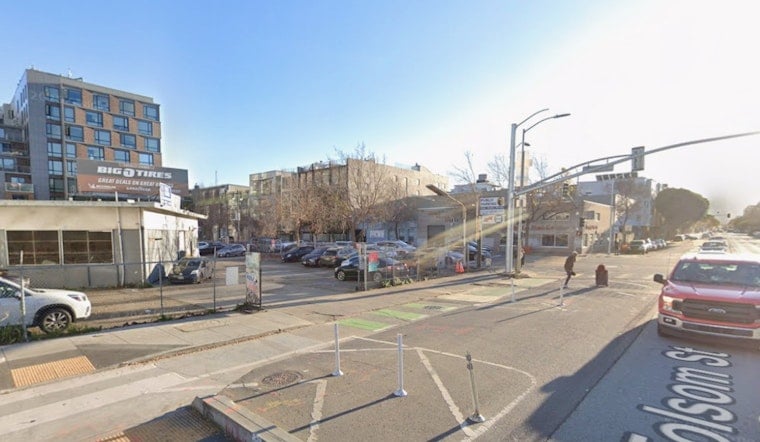
A 14-by-48-foot billboard went up in late July at the corner of Sixth and Folsom streets in San Francisco's SoMa district, declaring ChatTJB the leading chat interface powered by AI. There's just one catch: the entire operation is a single person, artist and former Google employee Tucker Bryant, reading and typing back every response himself.
The billboard's fine print reveals the joke: ChatTJB's AI doesn't stand for artificial intelligence, it stands for Average Individual, according to the New York Post. That detail was largely obscured from street view by tree branches, as The SF Standard reported, meaning most passersby likely read the sign as just another Silicon Valley AI pitch before discovering the punchline. Bryant, a Stanford graduate, bought the $6,000 sign as a piece of performance art aimed at society's increasingly automatic reliance on artificial intelligence, per the Post's reporting.
ChatTJB is registered under Tucker Bryant Enterprises LLC, a California limited liability company, according to the project's own terms of service. The website leans hard into tech-industry parody, describing the service as artisanal intelligence, handcrafted by a single human being, and a single-operator large language experience, or LLE, as Futurism reported. It even claims to run on a proprietary biological reasoning substrate that only delivers answers when the operator is awake and motivated.
One Man, Thousands of Messages
Bryant told the Post he personally answered all of the requests that came in, speaking to roughly 1,000 people a day. At peak demand, ChatTJB reportedly received about 5,000 requests per hour, and the project has taken in more than 30,000 questions total, per the Post's reporting. Queries have ranged from relationship advice and dinner recipes to house paint recommendations, according to the SF Standard's account of the project's early days.
To keep pace, Bryant worked up to 10 hours a day typing as fast as possible on his phone and laptop, deliberately ignoring spelling mistakes to save time, the SF Standard reported. When users requested images, he hand-drew MS Paint-style scribbles instead of generating anything automatically. The site was temporarily overwhelmed after viral social media clips sent traffic spiking, according to Futurism.
Safeguards Added as Demand Grew
What started as satire quickly forced Bryant to build out real infrastructure. ChatTJB now warns users that most queries may not get a response for a long time, and the project has added message triaging, an onboarding quiz, and other unspecified safeguards. Its terms of service also set a minimum user age of 13, explicitly disclaim any medical, legal, or crisis counseling, and keep a permanent link to the national 988 Suicide and Crisis Lifeline inside the chat interface.
Bryant told Futurism the project is meant to make users think twice before accepting chatbot answers at face value — a message that lines up with new research on how people relate to AI output. A January 2026 Wharton School paper titled “Thinking Fast, Slow, Artificially,” from researchers including Steven D. Shaw and Gideon Nave, coined the term cognitive surrender for how readily people trust AI-generated answers with little scrutiny, according to Wharton Executive Education. In a study of 1,372 participants, nearly 80 percent adopted AI-generated responses even when the system was intentionally programmed to give false answers, with confidence in those wrong answers rising by almost 12 percentage points.
Growing Into a Community Project
Bryant now plans to turn ChatTJB into a community project, introducing volunteers slowly and seeking out other average individuals to help operate it, according to the Post. The plan is to route incoming prompts to approved community members rather than funneling everything through Bryant alone, per ChatTJB's own description of the project. The stated goal, somewhat cheekily, is to keep delivering a really average or bad experience — a wink at the cracks that can show up when overworked systems, human or automated, try to scale.
Local outlet Gazetteer SF was among the first to cover the billboard, noting that tech-weary San Francisco residents actually embraced it as a rare piece of AI advertising they enjoyed. That reaction fits a broader local pattern: in July, Hoodline reported on Notion's AI Dread hotline billboards, which routed anxious callers to office ambient soundscapes and generated thousands of calls across the city's tech corridor.
Where Satire Ends and Regulation Begins
Bryant's transparent disclosure stands in sharp contrast to a practice regulators call AI washing, in which companies falsely market human-driven or nonexistent tools as autonomous AI. The Federal Trade Commission has brought more than a dozen AI washing enforcement actions in 2025 and 2026, according to Ashurst Perkins Coie, and under Section 5 of the FTC Act, marketing a service as an automated system when it actually relies on manual human labor counts as illegal deceptive advertising. Because ChatTJB openly tells users a human is behind the curtain, it sidesteps the legal exposure that has ensnared other companies.
The idea of dressing up human labor as a machine is not new. It traces back to the 18th-century Mechanical Turk chess-playing automaton hoax, a name Amazon founder Jeff Bezos revived in 2005 for what he called artificial artificial intelligence — crowdworkers doing tasks computers of the era couldn't handle, according to Gizmodo. Amazon began phasing out that original Mechanical Turk platform in mid-2026 as generative AI took over more basic micro-tasks, the outlet reported, leaving Bryant's one-man revival of the bit as a strange full-circle moment for a very old joke about who, or what, is really answering on the other end.




