
























































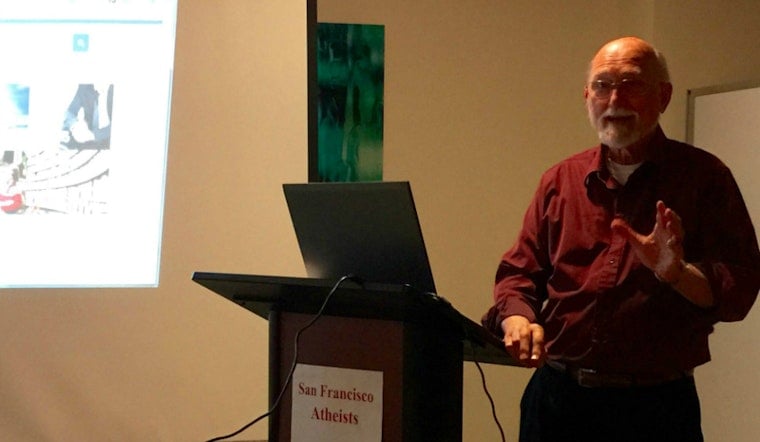
Even though our society claims to be less and less religious, it's still often intimidating for people to come right out and say they're atheists. That's why the San Francisco Atheists exist: To provide friendship, education, and activism, and to create an accepting space where no one has to feel they're being judged for their lack of belief in a god or the supernatural.
The group generally meets at 4:30pm (doors open at 4pm) the last Saturday of the month in the FiDi, except for June and December, when it holds solstice events. Lately, they've been in the Niantic Room of the Club Quarters Hotel at 424 Clay St. The next meeting on May 30th will feature former Presbyterian minister Chris Highland talking about "Nature is (Super) Enough." Meetings are free, but donations are welcome.
The group was founded in the mid-1990s by Jim Helberg and Dave Kong. "One of the first big events was a secular memorial right after 9/11," said David Fitzgerald, a volunteer with SF Atheists (they don't have board members or titles). "It was one of the first things that really galvanized us as a community." They also organized the world's first atheist film festival, which ran from 2009–2013. Fitzgerald is also an author who wrote Nailed: Ten Christian Myths That Show Jesus Never Existed at All and The Complete Heretic's Guide to Western Religion Book One: The Mormons.
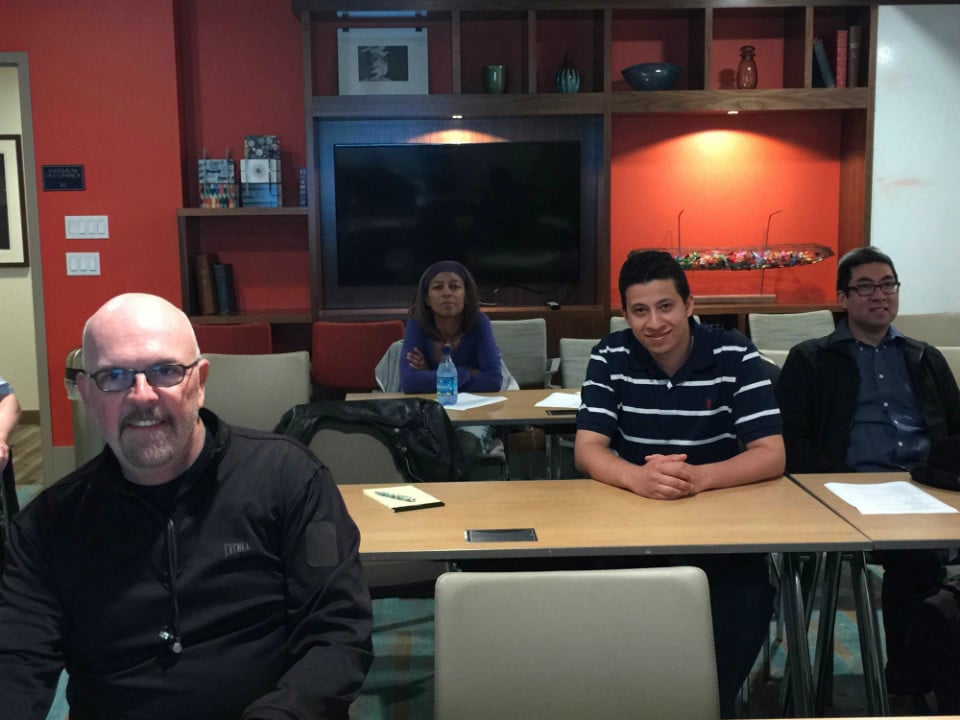
A couple of dozen to over 50 people from all over the Bay Area attend monthly meetings, depending on the program. Past meetings have included Kevin Matamoros of the Military Religious Freedom Foundation; Jeremiah Camara, who made the film Contradiction: A Question of Faith, about the negative effect of religion on African American communities; and Terry Plank, President of the Board of Directors of the Clergy Project, which provides "a safe haven of protected, anonymous online community for former and active religious professionals who no longer hold to supernatural beliefs."
Plank talked about his work helping clergy and former clergy "come out" as atheists—an idea that sounds improbable, until Plank tells his story and displays the website, which says 625 religious professionals are in the Clergy Project. Many members, he said, live in small communities built around the local churches, and they'll lose everything—job, family, friends—if they reveal they no longer believe. Plank himself became a pastor because his wife went to church. "We burned records back in the '70s because if you played rock records backwards, they have demonic messages," he said. "Holy shit! It's embarrassing."
Atheists meetings attract a wide range people, younger to older, of various ethnic backgrounds and from many walks of life. Ahmed Abdelazeem of Concord attended the April meeting. He moved to the United States on a student vista in August 2014 from Egypt, where he has been attacked for his non-beliefs and his friends have suffered death threats and have been jailed. "You have to worry every second about your life because even the regular people there who aren't religious, are religious," he said. "Everything relates to God or prophet or Islam. All of them are extremists. In Islam, the punishment for ignoring Mohammed is death. This is Sharia law."
"We kind of have it easy being atheists here in San Francisco," said Susan Fink, another SF Atheists volunteer." It's unimaginable to me not being free to do what we do. We don't take it for granted."





