

























































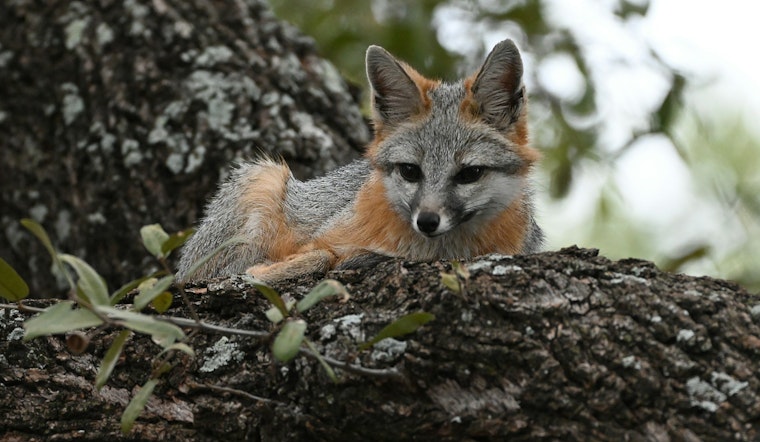
Every morning before dawn for the past decade, Bill Leikam has walked the edges of a six-acre strip of marshland near the Palo Alto Baylands, flashlight in hand, calling out to his unlikely research subjects. "Hey! Little fox!" The gray foxes know him now. They emerge from the brush, yellow-white eyes glowing in the beam of his headlamp, curious rather than fearful.
Leikam—known around the Bay Area as "The Fox Guy"—may be witnessing something remarkable: the early stages of animal domestication happening in real time. While his gray foxes haven't been studied for the specific traits seen in self-domesticating red foxes across the Atlantic, a groundbreaking 2020 study suggests that urban foxes worldwide may be evolving doglike characteristics simply by living near humans, according to Science.
The research, published in the Proceedings of the Royal Society B, compared skulls from rural and urban red foxes in the United Kingdom and found striking differences. Urban foxes had noticeably shorter and wider muzzles, smaller brains, and reduced differences between males and females—all hallmarks of what Charles Darwin called "domestication syndrome."
The Russian Fox Experiment Comes to Life
"What's really fascinating here is that the foxes are doing this to themselves," evolutionary biologist Kevin Parsons of the University of Glasgow told the BBC, according to Science. "This is the result of foxes that have decided to live near people, showing these traits that make them look more like domesticated animals."
The findings mirror a famous ongoing experiment that began in 1960 in Siberia, where scientists bred only the least aggressive foxes generation after generation. The creatures developed stubby snouts, floppy ears, and even began to bark—transforming into tame, doglike canines through deliberate selection, according to Science.
"I'm not so much surprised as delighted," by the urban fox study, says Lee Dugatkin, an evolutionary biologist at the University of Louisville. "This is a 'natural experiment' that is very much in line with what the Russian experiment has found."
Bay Area's Fox Population Exploding
While the British study focused on red foxes, the Bay Area has seen its own fox population surge in recent years. Gray foxes—native to California and one of the last predators remaining in the region—have become increasingly visible across the Peninsula, East Bay, and even in San Francisco proper.
"They might be under a deck and stay there for a month but then move on," Leikam told SFGATE. "They're generally pretty timid but they get used to people quickly, so don't feed them, just enjoy them for being around."
According to Sierra Club, Leikam's daily observations near the Bayshore Freeway have documented scientifically important behaviors never before seen in gray foxes, including "helper females" raising communal young—a behavior known in coyotes but not previously documented in this species.
The foxes aren't confined to open spaces. According to Oakland Magazine, sightings in residential East Bay neighborhoods have jumped dramatically in recent years. Foxes have been spotted in the Oakland hills, near El Cerrito Plaza, and even along Berkeley's Ohlone Greenway below Martin Luther King Jr. Way. In 2020, Bay Nature reported the first gray fox spotted in San Francisco since 2004 had started a family in the Presidio.
Why City Living Changes Foxes
The skull changes documented in British urban foxes tell a story of adaptation to city life. Rural fox skulls are shaped for speed, designed to chase down quick, small prey. Urban foxes, by contrast, have evolved to be scavengers.
"Perhaps that's because in the city, a fox can simply stand at a human trash pile and feed on the food we've tossed out, where they may encounter more bones that can only be crushed with stronger jaws," Parsons speculates, according to Science.
Steve Bobzien, ecological services coordinator for the East Bay Regional Park District, told Oakland Magazine that gray foxes are "closely associated with riparian areas. They're really closely associated with the stream corridors; they follow where the water is." Many Bay Area watersheds flow through suburban and urban areas, creating natural highways for foxes to move between wildlands and cities.
The Path That Stops Short
Despite these evolutionary changes, the urban red foxes are definitely not domesticated, Parsons emphasizes. But the study shows how exposure to human activity can set an animal down this path, says Melinda Zeder, an emeritus archaeologist at the Smithsonian Institution's National Museum of Natural History, according to Science.
Like early dogs, urban foxes need to overcome their fear of humans to get close enough to eat our trash. And that may be the spark that leads to other biological changes. Fascinatingly, foxes have started down this domestication path before in many parts of the world—their bones show up in early farming communities—but unlike wildcats, who transformed into today's house cats, foxes never became fully domesticated.
"They never move any farther down the path to domestication," Zeder notes. "We don't know why."
Living with Urban Foxes
For Bay Area residents encountering these increasingly common neighbors, wildlife experts offer simple advice: let them be. Of the region's predators—coyotes, bobcats, mountain lions, and foxes—foxes pose the least danger to humans, according to Mercury News. They're simply too small and too leery to do significant harm.
The Bay Area has both gray foxes (native) and red foxes (non-native), with the latter posing ecological concerns. Eastern red foxes have contributed to declines in endangered California clapper rail populations and threaten salt marsh harvest mice, California least terns, and snowy plovers. Ironically, coyotes have been doing a "pretty good job" of controlling red fox numbers.
Leikam and his research partner Greg Kerekes have a grander vision beyond just studying fox behavior. According to National Wildlife Federation, they're working to create a comprehensive San Francisco Bay Area Wildlife Corridor to ensure protection of the region's natural heritage as development continues.
"I think we are seeing some of the original ancient passageways are partially intact and that the animals in some cases are not giving up, even with cities moving into their areas," Leikam notes.
Whether Bay Area foxes are undergoing the same skull changes as their British cousins remains an open question. "Something I thought would be an interesting extension to this study is looking at populations from other urban and rural pairs throughout the range of modern foxes," evolutionary biologist Danielle Fraser told Canadian Geographic.
For now, The Fox Guy continues his twice-daily walks along the Bayshore Freeway, documenting the lives of creatures that may—or may not—be slowly transforming themselves into something new. His foxes have distinctive personalities, complicated social relationships, and an increasing comfort with human presence. Whether they're on the path to domestication or simply adapting to survive in shrinking habitat, one thing is clear: they're not giving up on the Bay Area, even as the Bay Area continues to encroach on them.
As Pat Jones Hise, an Oakland hills resident, told Oakland Magazine: "I have been completely charmed each of the probably three times I have seen a fox in our neighborhood. Quite lovely, and they seem to be jaunty almost."
Editor's Note: Image replaced following the publishing of this article.




