

























































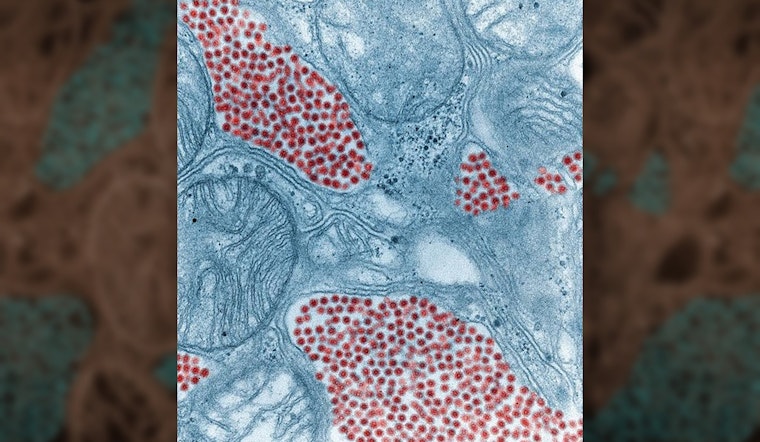
As the Massachusetts Department of Public Health (DPH) confirmed the presence of Eastern equine encephalitis (EEE) virus in mosquito samples for the first time this year, concerns grow around the late season emergence that could threaten public and animal health reported the Commonwealth. Collected on August 30 in Worcester County, these samples serve as a stark reminder of the looming threat of EEE in Douglas, Dudley, Southbridge, Sturbridge, Uxbridge, and Webster, where the risk level is now officially categorized as moderate.
Commissioner Robert Goldstein, MD, PhD, acknowledged that the late emergence of EEE in the season might mitigate the risk levels from rising too much or too quickly. However, he stressed that mosquito-borne disease risks continue until the first hard frost. The return of the virus in mosquitoes after a quiet spell in 2021 and 2022 raises concerns about the potential spread to humans and animals, even this late in the season.
EEE represents a rare, serious, and potentially fatal disease. Although its spread to humans typically happens through the bite of an infected mosquito, the virus claimed 12 human lives in Massachusetts in 2019 and another in 2020, while no cases were reported in 2021 or 2022. The re-emergence of EEE in 2023 compels individuals to adhere to both personal and community-wide interventions aimed at thwarting further transmission.
The Mass.gov resource on mosquito-borne diseases offers valuable information on preventing mosquito bites, mosquito-proofing the home, and protecting animals. Insect repellent, especially ones containing EPA-registered ingredients like DEET, permethrin, picaridin, oil of lemon eucalyptus, or IR3535, remains a mainstay in EEE prevention. Notably, DEET products should not be used on infants under two months of age and should be used in low concentrations on older children. Oil of lemon eucalyptus is not recommended for children under three years of age.




