

























































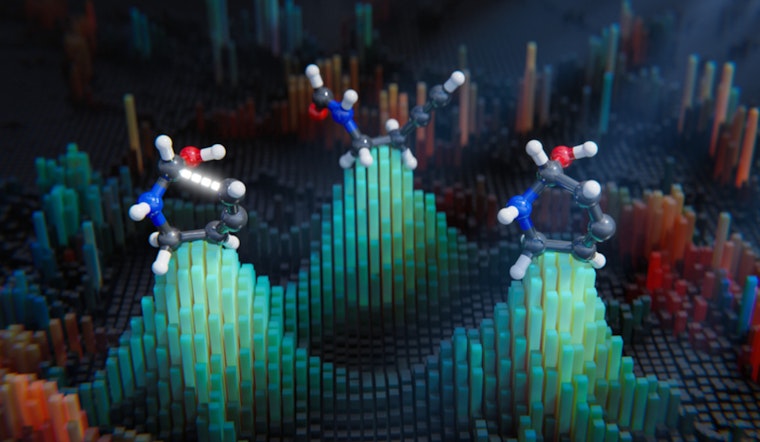
In a groundbreaking shift for the field of chemistry, a team of MIT scientists has developed a machine-learning model that has the potential to rapidly revamp the way researchers predict and facilitate chemical reactions. According to MIT News, this novel model accurately captures the transition states of chemical reactions—a previously notoriously difficult task—in mere seconds.
Traditionally, identifying the fleeting transition states of molecules during a reaction, which indicate an energy threshold before a reaction's point of no return, has been akin to trying to observe a sprinter at the peak of their leap. Now, thanks to the MIT researchers, a machine-learning alternative can dramatically speed up this process, eschewing the time-consuming techniques based on quantum chemistry in favor of swiftly calculating these elusive structures.
Heather Kulik, an associate professor of chemistry and chemical engineering at MIT and the senior author of the study, highlighted the fundamental role transition states play. "Knowing that transition state structure is really important as a starting point for thinking about designing catalysts or understanding how natural systems enact certain transformations," Kulik told MIT News.
The research, which is making scientists rethink traditional methods in the domain, has been detailed by lead author Chenru Duan, PhD '22, along with contributions from others at MIT and Cornell University, in a paper published in Nature Computational Science. By employing a diffusion model, the team's computational method defied the previous machine-learning models' limitations, capturing multiple reactant orientations without the need to individually model each variance—a step that used to add significantly to computation time.
Testing on approximately 1,000 unfamiliar reactions demonstrated the accuracy of the MIT model. The proposed structures were within 0.08 angstroms (one hundred-millionth of a centimeter) of those generated using traditional quantum techniques. This validation underscores the model's robustness, even when scaling up to handle larger molecules, which is crucial for the synthesis of an array of compounds like pharmaceuticals and fuels.
The implications of this work extend beyond the lab. The model promises to aid in developing more efficient catalysts and could lend insight into long-standing questions about the chemical reactions crucial for the origins of life on Earth or the interactions that exist on other planets. Jan Halborg Jensen, a professor of chemistry at the University of Copenhagen who was not part of the research, praised the study, noting, "This is the first paper I have seen that could remove this bottleneck," in reference to the difficulties faced in automating the prediction of chemical reactivity.
Support for the research came from the U.S. Office of Naval Research and the National Science Foundation, emphasizing the strategic importance of these advancements in understanding and harnessing chemical reactions.





