

























































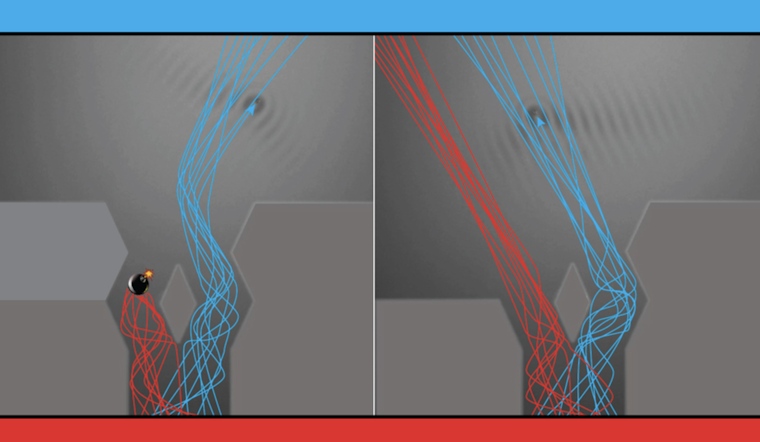
In a groundbreaking study that blurs the lines between the quirky quantum world and our classical understanding, MIT mathematicians made a splash by recreating a quantum bomb tester using bouncing silicone oil droplets. The experiment, typically fraught with complex quantum behaviors, was scaled to a simple, tangible level, suggesting a more intuitive grasp of the quantum realm might be possible. By mirroring the statistical outcomes predicted for quantum particles with ordinary droplets, the researchers offer a fresh perspective that could ultimately challenge some of the bedrock concepts underlying quantum theory.
According to a report by MIT News, the researchers, Professor John Bush and former MIT postdoc Valeri Frumkin, carefully crafted a macroscopic setup that could mimic the wave-particle duality of a photon. This duality, a cornerstone of quantum mechanics, normally presents itself on scales invisible to the naked eye, yet the team's experiment demonstrated such phenomena on a visible, touchable scale. A droplet's pilot waves, similar to the photon's quantum behavior, were shown to detect the presence of a 'bomb' without directly encountering it, expanding our insights into the enigmatic world of quantum particles.
Published in Physical Review A, the study portrays the droplet as a classical proxy for quantum entities. When launched into a silicon oil bath designed to resemble a quantum interferometer, the droplet's subsequent trajectory and interactions allude to the way a quantum particle might behave when sensing a bomb. "Here we have a classical system that gives the same statistics as arise in the quantum bomb test, which is considered one of the wonders of the quantum world," John Bush told MIT News.
The MIT experiment took cues from physicist Yves Couder's discovery in 2005, which itself was an ode to de Broglie's pilot wave theory from 1927. By making fluid vibrate, just short of causing waves, the experiment deposited droplets to 'walk' across the bath, laying out wave fields that would steer the droplets. This setup, reimagined by the MIT team to test the quantum bomb scenario, sidesteps the more abstract quantum descriptions by displaying concrete, observable dynamics. "Not only are the statistics the same, but we also know the dynamics, which was a mystery," Valeri Frumkin explained.
This intriguing breakthrough was met with interest from the scientific community, with theoretic physicist Matthieu Labousse, not involved in the study, asserting, "It is very surprising that many examples thought to be peculiar to the quantum world can be reproduced by such a classical system." With possible implications for understanding particle physics and revamping quantum theory, the MIT team's findings are paving a novel path for future research. The implications of this research, supported in part by the National Science Foundation, may illuminate formerly obscure mechanisms of quantum mechanics and potentially pave the way for new applications and technologies rooted in what once was considered an exclusively quantum phenomenon.





