

























































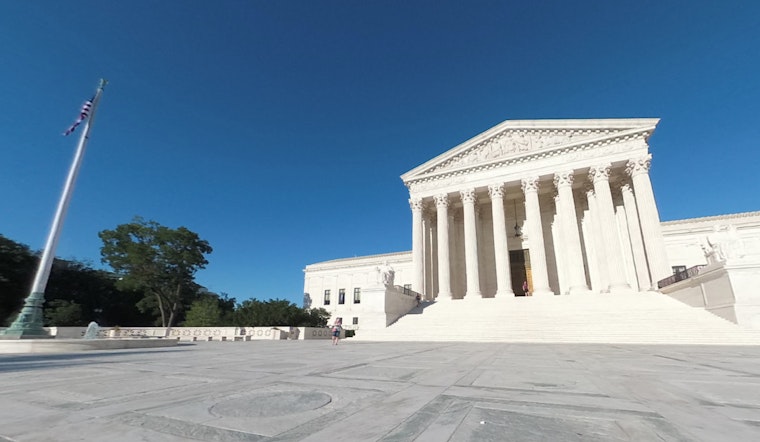
In a decisive turn of events, the U.S. Supreme Court has ruled in favor of maintaining the contentious new voting maps in Galveston County, Texas, positioning the county to proceed with the 2024 elections according to the disputed boundaries. This ruling comes in the wake of lower courts branding the maps as violative of the Voting Rights Act, yet the highest court in the nation stood by a 6-3 vote, essentially securing a win for Galveston County officials who have been embroiled in the legal tussle over the redrawn districts.
Galveston County's political landscape, particularly the district helmed by Commissioner Stephen Holmes, finds itself at the crux of a broader dialogue on electoral representation, with the district being a singular beacon where a majority of the populace are people of color, according to the Houston Chronicle. Holmes' predominance in the area springs from the very demographic that the maps seek to disband, a move that all but ensures a dilution of minority influence come 2024, a stark shift from the prior thirty-year norm where black and Latino residents comprised 58 percent of one commissioner precinct.
As the Supreme Court majority kept their reasoning under wraps, leaving the controversial maps unaltered in the immediate term, the dissenting liberal justices raised poignant concerns. "In imposing a different map acknowledged to violate current law—on the theory that the Circuit might someday change that law—the Court of Appeals went far beyond its proper authority," Justice Elena Kagan penned in dissent, a snippet of which the Washington Post highlighted, articulating a sentiment shared by Justices Sonia Sotomayor and Ketanji Brown Jackson.
The see-saw battle over the maps first saw U.S. District Judge Jeffrey Vincent Brown, crucially a nominee of former President Donald Trump, decreeing that the county's new maps faltered against the standards set by the Voting Rights Act, this in itself was a potent development given the judge's directive to deploy a rectified map that "remedies the vote dilution present," only for the 5th Circuit to hit pause and wrangle back control, retaining the contested map while awaiting a fuller hearing as the full complement of 5th Circuit judges have signaled an appetite to overturn existing precedent, which they will deliberate in May, following a preliminary indicator of their leanings voiced last week, one portending a departure from the decades-old legal foundation, as reported by the Washington Post.
At the core of the dispute, experts like Derek Muller from the University of Notre Dame have highlighted, as the Houston Chronicle reports, Section 2 of the Voting Rights Act, which traditionally mandates districts to be sculpted in a way that minority groups are not hamstrung in electing their preferred representatives. The current alignment of the circuit courts, meshed with the Supreme Court's latest move, fosters a fraught, if not uncertain, horizon for the Voting Rights Act’s application and the very composition of electoral districts harboring minorities in Galveston County and potentially beyond.





