

























































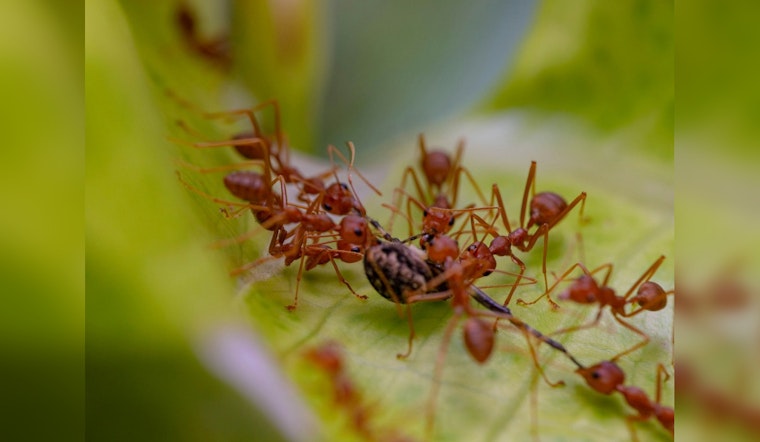
As the fire ant season descends upon Austin, residents are gearing up for an annual battle with the invasive pests known for their painful stings. Judy Barrett, a gardening author, suggests an organic mixture to combat these ants without the need for harsh chemicals. The formula, which includes orange oil, molasses, and liquid compost, has been recommended by the 'Compost King' Malcolm Beck, according to an article published by the Austin American Statesman. Meanwhile, Texas A&M University researchers are drawing inspiration from the fire ants' resilience and social strategies to revolutionize materials science.
While fire ants wreak havoc on local gardens and outdoor spaces, their unique ability to organize, form structures, and adapt to their environment provides valuable insights into the creation of transformative materials. At Texas A&M University, a team led by Associate Professor Taylor Ware has developed a shape-changing rubber technique inspired by how fire ants bind together to form rafts. "You can have something that was flat and would bend, you could have things that twist, you can have things that morph that fold into different geometries," Ware told KXAN.
To deal with the immediate issue of fire ants, the organically inclined have a couple of options. The daytime application of the aforementioned formula, or the use of spinosad bait as an alternative treatment during the evenings, is also recommended. Organic solutions seem to be the preferred choice amongst those concerned about the environmental impact of traditional pesticides. For those unfortunate enough to be on the receiving end of ant stings, Dr. Allen Lieberman from Austin Family Allergy and Asthma recommends antihistamines and allergy medicines to manage symptoms, as per the information obtained by the Austin American Statesman.
The invasive fire ants are known for their painful stings and tenacity, but also, in a twist of fate, have become muses for scientific and technological innovation. The research on the shape-changing rubber is still in the testing phase, with potential commercial applications expected in the coming years. Funded by the National Science Foundation, the Army Research Office, and the National Institutes of Health, this development is one example of how even the most vexing of creatures can inspire advancements that benefit humanity.



