

























































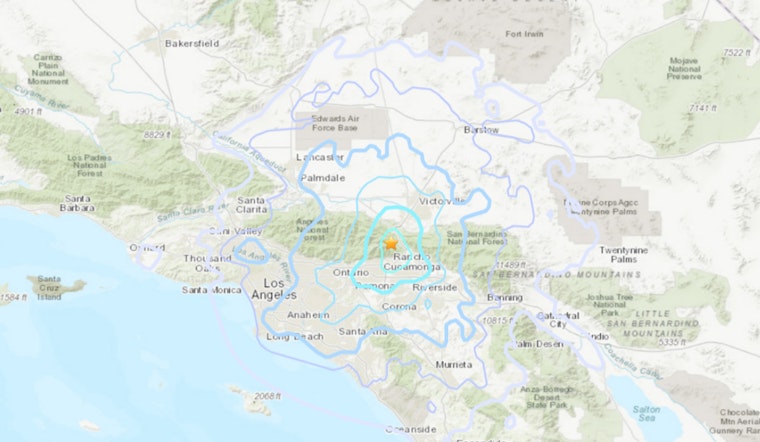
A rumble rolled through Southern California on Friday as a magnitude-4.2 earthquake centered near Lytle Creek, in San Bernardino County's San Gabriel Mountains, was felt far and wide. The quake, occurring 60 miles northeast of downtown Los Angeles, prompted reports of shaking in various communities including Long Beach, Riverside, and parts of Orange County, according to NBC Los Angeles. Originally striking with a 4.6 magnitude, adjustments were made by seismologists who settled at a 4.2 rating after the temblor hit around mid-morning; yet in this landscape of quivering faults and rubble, there was a sigh of relief as no damages or injuries surfaced in the wake of nature's latest stir.
This seismic event occurred where the notorious San Andreas and San Jacinto faults meet, a spot not unfamiliar with temblors, having experienced a significant 5.2 quake back in 1970. Residents were keen to share their experiences, with one Fontana local describing the sensation as a slow roll followed by a booming noise and ending with a sharp jolt on her social media account, not only the ground felt it but the people, too, their nerves as ever on the razor's edge when the earth decides to dance beneath their feet. ABC7 relayed accounts of the quake being felt across vast distances, reaching areas such as Watts, Anaheim, and downtown Long Beach.
The initial confusion over the earthquake's magnitude saw it flounder between 4.1 and 4.6 before the United States Geological Survey confirmed it as a 4.2. Seismologist Dr. Lucy Jones provided context via social media, noting the historical quake activity in this region and the potential for more significant tremors given the length of the San Andreas fault. "When we have a San Andreas earthquake, that's going to be one of our worst ones," she cautioned in an interview with ABC7, elucidating that the length of a fault is proportional to the potential magnitude of an earthquake it can produce.
In the absence of immediate reported damages or injuries, Southern California exhaled fractionally, well aware that the sprawling San Andreas is prone to more frequent seismic activities due to its rapid movement, yet, the ever-present threat looms in the minds of Californians; Dr. Jones' words echoing a stark reminder, "whenever something happens near the San Andreas, we take notice," emphasizing the unpredictable power of the longest fault in the state. Fire departments in San Bernardino and Los Angeles counties have been vigilant, but as of yet, there's been no need to spring into action, a moment of calm hanging in the balance as the earth rests momentarily, locals to tuning into every vibration that hints at the fault's next shift.





