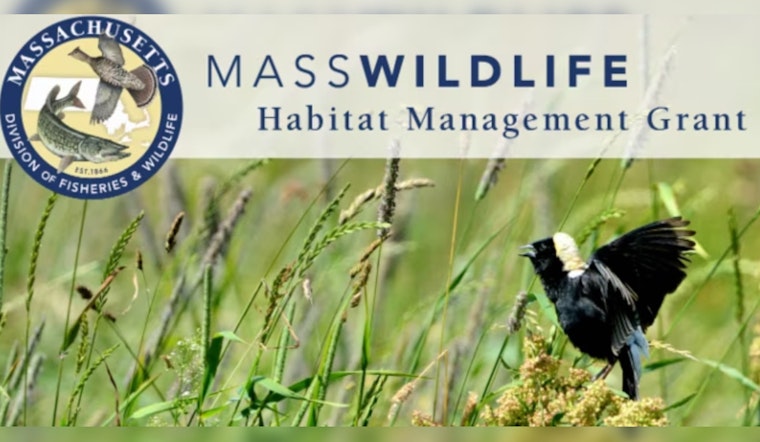
The Healey-Driscoll administration is putting its money where its mouth is when it comes to Massachusetts' wildlife and climate resilience. The state has carved out over $365,000 in grants intended to spruce up 234 acres of wildlife habitat, courtesy of the Department of Fish and Game's Division of Fisheries and Wildlife, also known as MassWildlife. This cash infusion aims to bolster partnerships with entities that hold the keys to the commonwealth's conserved lands, which are not typically under state control.
Department of Fish and Game Commissioner Tom O’Shea underlined the importance of such partnerships, "Partnership and collaboration will be essential for meeting our ambitious biodiversity, and climate goals. Most forests and other wildlife habitats in Massachusetts are not state-owned, and we rely on conservation organizations, cities and towns, private landowners, and other partners to greatly expand our impact," O’Shea said, according to a press release. These funds will aid in targeting areas that are currently under siege by invasive species and climate threats, chalking up to a proactive stand against ecological degradation.
MassWildlife's Habitat Management Grant Program (MHMGP) will distribute the grants among five organizations and two municipalities, strengthening habitats for wildlife and enhancing public outdoor recreation opportunities. This strategic deployment of resources reflects the administration's commitment to not only addressing the plights of imperiled species but also enhancing the state's recreational and sporting prospects.
"This program provides us with the unique opportunity to not only directly benefit threatened species, but also create new outdoor recreation opportunities and support the sporting community," O'Shea added, in a statement obtained by Mass.gov. The survival of rare moths, butterflies, and combating the range expansion of the southern pine beetle into Massachusetts' pine forests, are among the focal points, of this operation.
A standout recipient, the Town of Falmouth, snagged $70,000 to wrestle with invasive species in its sandplain grasslands, improving the ecosystem connectivity and bolstering rare species habitats. Nantucket also made significant headway with the Nantucket Conservation Foundation and the Nantucket Island Land Bank collectively receiving $149,700 to safeguard the pitch pine barren habitat and manage pine barrens at Gardner Farm against the southern pine beetle threat.
The ecological chess game continues upstate with the Berkshire Natural Resources Council setting its sights on a $28,930 bounty to tackle invasive plant species in the Housatonic River floodplain. Meanwhile, down at Smelt Pond, Kingston's local government has secured $23,765 to address the invasiveness of variable‐leaved milfoil, which degrades water quality by outcompeting native flora.
Legislative officials have chimed in on the grants' value, with the likes of State Senator Susan Moran and State Representative Dylan Fernandes showing support for the administration's initiative. Moran praised the focus on the Cape and South Shore's unique ecological landscapes, while Fernandes noted, "These projects are not just for wildlife – they're an investment in the future of our communities and the well-being of everyone who cherishes our natural spaces," both comments as per statements on the Mass.gov announcements.
For those looking deeper into the MassWildlife Habitat Management Grants, the project breakdowns and future aspirations can be found on the program’s webpage.