

























































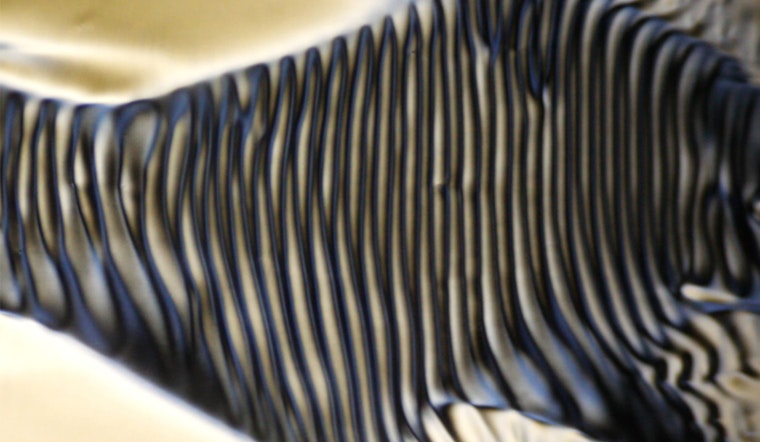
In a groundbreaking discovery that might reshape the frontier of materials engineering, MIT researchers have observed the spontaneous formation of chiral structures in a liquid crystal, a medium traditionally perceived as nonchiral. The study, detailed in Nature Communications, reveals how these large, twisted structures can emerge through the simple act of the material flowing at a certain rate.
The usual suspects of chiral materials have long been thought to exclusively arise from chiral forces or origins. However, the MIT team has managed to completely upend this notion by demonstrating that chirality can also spontaneously appear from nonchiral systems, providing a promising strategy to potentially design structured fluids in novel ways. "This is exciting because this gives us an easy way to structure these kinds of fluids," Associate Professor Irmgard Bischofberger of MIT's mechanical engineering department told MIT News.
This revelation comes from meticulously conducted experiments involving a nematic liquid crystal, a water-based fluid containing rod-like molecules. These molecules are typically aligned in one direction, but under certain slow flow conditions, they coalesce into striped, chiral formations. The discovery was initially made during at-home experiments by Qing Zhang PhD '22, leading to an official study where the phenomenon was documented using a microfluidic channel and observed with a microscope.
The chiral patterns recorded in the slow-flowing liquid crystal took scientists by surprise with their ordered nature and the conditions under which they formed. Aside from the initial curiosity, practical applications abound for this finding. The chiral liquid crystals have the potential to serve as intricate scaffolds for molecular assembly, or as sensitive optical sensors that change interaction with light based on their structure. "There's this magic region, where if you just gently make them flow, they form these large spiral structures," Zhang explained in her statement to MIT News.
The researchers propose that the unexpected chiral formations arise when the fluid reaches an equilibrium between elasticity and viscosity—how a material deforms versus how it flows. Bischofberger's surprise is shared by colleagues, with this turning point highlighting a newfound ability to manipulate the structure of materials at a microscopic level. Her further statement to MIT News: "It's kind of amazing that individual structures, on the order of nanometers, can assemble into much larger, millimeter-scale structures that are very ordered, just by pushing them a little bit out of equilibrium."
The team is now looking forward to exploring the full potential of this occurrence, eyeing applications that span from optical sensors to drug delivery systems.





