

























































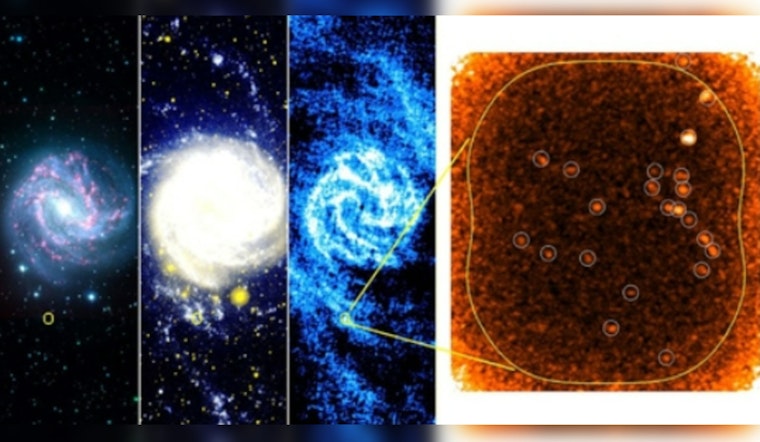
In an intriguing revelation that adds another layer to our understanding of the cosmos, a team of astronomers, including UMass Amherst graduate student Amanda Lee, has made a notable discovery concerning star formation at the outskirts of galaxies. Tackling a longstanding astronomical puzzle, Lee and her colleagues turned their attention to the enigmatic presence of nascent stars in these unlikely regions, far from the bustling centers traditionally known as stellar nurseries.
While it has been established for years that the denser areas of galaxies are fertile grounds for star birth, a surprising find by NASA's GALEX satellite nearly two decades ago revealed that the galaxy's edges are also cradling young stars. Jin Koda, who led the research from Stony Brook University, highlighted the perplexing nature of this discovery. "This is a nagging mystery since their discovery by the NASA’s GALEX satellite 18 years ago," Koda said, as reported by UMass News.
To get to the bottom of this, astronomers used the state-of-the-art Atacama Large Millimeter/submillimeter Array (ALMA) to peer into the remote fringes of the spiral galaxy M83 which sits at a staggering distance of 15 million light-years from Earth. There, they discovered 23 molecular clouds, indicating that these regions serve as a backdrop for the drama of star formation.
The nature of these clouds proved distinct from the molecular clouds in the galactic centers, where star formation is a more common spectacle. Here in the outskirts, only the dense cores were visible, suggesting a different mechanism at play. Crewed by diffuse atomic gas, the typical galactic center molecular cloud births stars by condensing and forming dense cores. This process, however, proved much less efficient at the galaxy's edges. “we still do not understand why this atomic gas does not efficiently become dense molecular clouds and form stars. As often is the case in astronomy, pursuing answers to one mystery can often lead to another. That’s why research in astronomy is exciting.” Lee said as the UMass News article detailed her findings.
The research, which involved a multifaceted approach utilizing instruments such as ALMA, the Karl G. Jansky Very Large Array, and the Green Bank Telescope, underscores the complexities and continuous surprises in the field of astronomy. The investigators, including Lee, who is studying with UMass’s Rob Gutermuth and Grant Wilson, underlined the thrilling and unpredictable nature of cosmic exploration as the study of one mystery often unveils another.





