

























































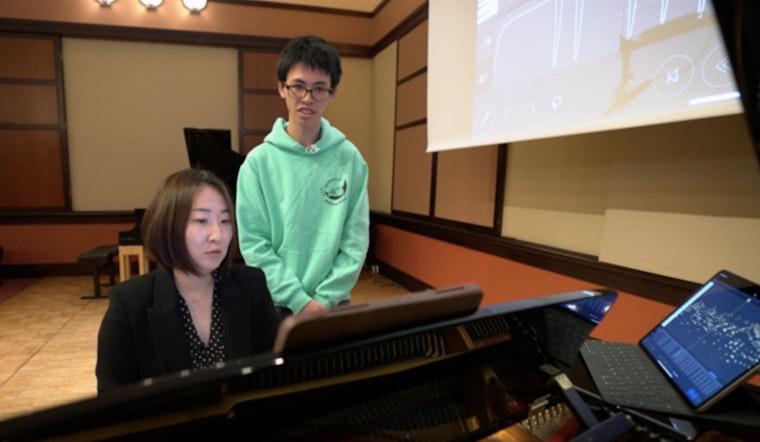
The future of musical instruction at MIT is hitting a high note with the recent residency of an innovative and data-savvy grand piano, the Steinway Spirio | r, which allows performers to record and play back their music with an unprecedented level of detail. First-year student Jacqueline Wang and other members of the MIT community were treated to a novel experience as they listened to their own performances echoed back faithfully by the Spirio, noted in a report by MIT News.
These listening sessions have unveiled contrasts between perceived and actual playing, a revelation that startled the participating pianists like Wang, who confessed to hearing her Mozart Sonata differently outside the performer's bench, saying "It sounds different from what I imagine I’m playing." The Spirio | r is not only a piano but essentially a high-tech sound lab that records the intricate nuances of live performances, capturing over a thousand levels of hammer strike sensitivity sampled hundreds of times per second, it turns out this instrument's capabilities might be a game-changer in music pedagogy and studies at MIT.
Keeril Makan, head of MIT's Music and Theater Arts, visions for the anticipated W18 music building to house such technology, which potentially augments not only for the 19 piano students of the Emerson/Harris Program but possibly for MIT's broader musically inclined student body, as music stands as one of the top minors at the institute with 1,700 enrollees in relevant classes each semester. The Spirio's nuanced playback offers a quality lost in traditional recordings, elucidated by pianist and lecturer Mi-Eun Kim, who argues that playback through speakers "sort of crunch everything down" whereas live performances boast dynamic range meant to fill a room.
The educational advantage of technology in the arts could be manifold, with MIT researchers like Praneeth Namburi from MIT.nano Immersion Lab tapping into the Spirio's data to analyze piano players' physical movements, bridging music and movement science in unique ways. Namburi's work emphasizes the potential intersections across disciplines, enabled by this state-of-the-art instrument, "We used motion capture that can help us contrast the motion paths of experts such as Mi-Eun from those of students, potentially aiding in music education," he shared with MIT News.
Amid concerns that such technology may supplant traditional methods, or even the artists themselves, Kim assures that the Spirio | r, as a tool, enriches rather than replaces, the musical journey of learning, research, and performance. As MIT continues to blend its renowned technological prowess with the fine arts, tools like the Spirio | r are set to strike a chord in not only the university's musical future but also in the broader scope of interdisciplinary studies.





