

























































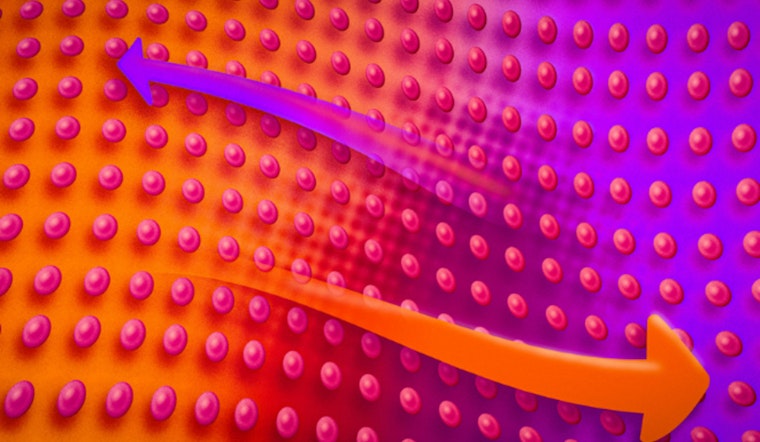
Physicists at the Massachusetts Institute of Technology have directly imaged the elusive "second sound" in a superfluid for the first time. This phenomenon, akin to a heat wave, showcases heat's ability to propagate back and forth in a manner similar to sound waves in certain extreme conditions. The findings, which could revolutionize our understanding of thermal conductivity in superfluids and other related materials, were reported by MIT on February 8th and published in the journal Science.
MIT's team, led by Martin Zwierlein, the Thomas A Frank Professor of Physics, has visualized this distinctive heat movement within a superfluid state—a frictionless fluid formed at temperatures nearing absolute zero. Unlike ordinary fluids where heat typically dissipates, in a superfluid, heat can behave as though sloshing, maintaining its momentum without engaging the physical particles of the material.“Now we can probe pristinely the temperature response of our system, which teaches us about things that are very difficult to understand or even reach.” Zwierlein told MIT News.
The research presents a clearer image of how heat operates distinctly within superfluids, contrasting sharply with its behavior in conventional materials. Assistant Professor Richard Fletcher explains the phenomenon with a vivid analogy: "It's as if you had a tank of water and made one half nearly boiling. If you then watched, the water itself might look totally calm, but suddenly the other side is hot, and then the other side is hot, and the heat goes back and forth, while the water looks totally still."
To capture these heat waves, Zwierlein's team developed a unique thermography technique, as supercooled gases do not emit infrared radiation that standard thermal imaging would detect. Instead of infrared sensors, the team used radio frequency to track how heat moves through the superfluid. The lithium-6 fermions used in their studies resonate at different frequencies based on their temperature—hotter regions ring at a higher frequency and vice versa. Zwierlein stated in the MIT publication, “For the first time, we can take pictures of this substance as we cool it through the critical temperature of superfluidity, and directly see how it transitions from being a normal fluid, where heat equilibrates boringly, to a superfluid where heat sloshes back and forth,”
The implications of this research stretch far beyond the lab, potentially informing everything from the behavior of electrons in high-temperature superconductors to the inner workings of neutron stars. The team is now setting its sights on extending its analysis to other ultracold gases and even larger systems. Support for this study arrived courtesy of the National Science Foundation, the Air Force Office of Scientific Research, and the Vannevar Bush Faculty Fellowship.





