

























































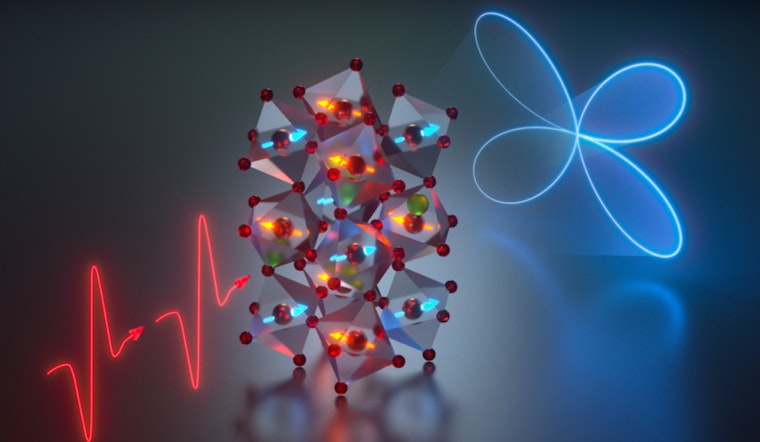
In an emerging breakthrough that could speed up our computers and help usher in an age of quantum computing, a team of researchers from MIT and the University of Texas at Austin has discovered new methods to influence magnetic waves using terahertz light; this discovery has the potential to lead to advanced information processing technologies. As detailed in a report by MIT, the study spearheaded by scientists including MIT's Zhuquan Zhang and the University of Texas's Frank Gao PhD '22, reveals a sophisticated control of spin waves or magnons, similar to how guitar players manipulate strings to alter sound pitch but on a magnonic scale.
The research, which was published in Nature Physics on January 24, involved the use of intense terahertz (THz) fields, laser pulses at extreme infrared frequencies to start a spin wave at its own frequency while also exciting another wave with a higher frequency, the outcome "really surprised us," Zhang remarked in the report because it provides a new perspective on energy flow control within magnetic systems, with graduate students from MIT contributing significantly to this development; alongside other notable collaborators.
Notably, the team overcame significant detection challenges associated with THz light—usually invisible to the naked eye—by developing a cutting-edge spectrometer, allowing them to unearth the complex interplay and symmetries of distinct spin waves. This critical instrument enables the measurement of THz signals with a mere single light pulse, as Gao explained, "These experiments would be otherwise impossible without the technique development which allowed us to measure THz signals with only a single light pulse."
Enthused by the low energy consumption of these magnetic bits as they move collectively, the scientific community has been closely watching the development of spin-based technologies, the study is trailblazing as it paves the way for high-speed spin-based information processing, which could manifest in devices such as magnonic transistors and quantum computing apparatus.
The endeavors of the researchers have been substantially backed by the U.S. Department of Energy Office of Basic Energy Sciences, the Robert A. Welch Foundation, and the United States Army Research Office, ensuring that the journey towards next-generation computing technology continues well-funded and supported. Not only does this point to a bright future for computing, but it proves that state-of-the-art scientific innovation is a collaborative feat involving dedicated minds from across various institutions.





