

























































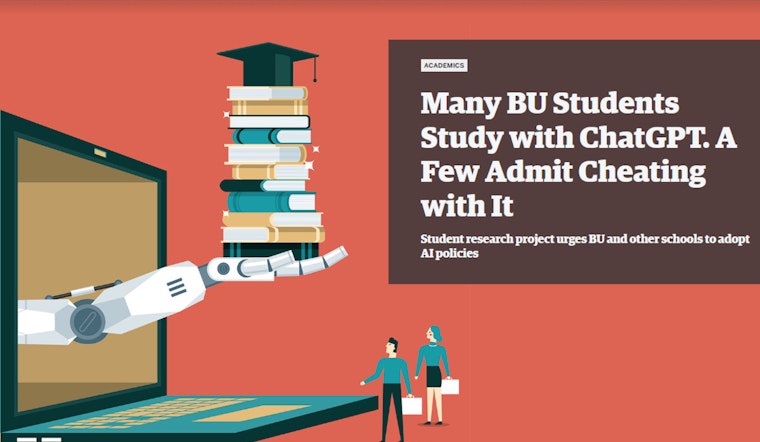
At Boston University, students have been getting cozy with a new study buddy known as ChatGPT, but some are crossing the line into cheating territory. According to a report by Boston University, a survey led by student Dima Ghalili found that a considerable number of BU students have employed the AI tool for everything from grammar checks to full-blown academic dishonesty. Notably, Ghalili's investigation under the University's Undergraduate Research Opportunities Program discovered that "8 percent admitted to generating text via ChatGPT that was incorporated verbatim into academic work without proper source credit."
The issue of academic integrity in the era of advanced AI is causing quite a stir on campus, with educators grappling with the evolving landscape of what constitutes study aids versus cheating tools. Although BU’s Faculty of Computing & Data Sciences has taken the lead by requiring students to acknowledge AI contributions, other academic units at the university remain in a policy-making limbo regarding the use of such technology. Moreover, an unnamed BU professor was forced to play detective, spotting ChatGPT's handiwork in student submissions which didn't align with previous drafts, a tale outlined by BU's coverage of the issue.
Kenneth Lutchen, BU's interim provost and chief academic officer, is anticipating the University AI task force's recommendations, hinting at a coordinated approach that might include mandatory attribution for ChatGPT-derived work. "The University community, their feedback, and their ideas have been vital to this process and we look forward to reporting back shortly on what we believe will be sensible pathways for the use of this technology at BU," Lutchen stated.
Opinions on the tech's use in academic settings are mixed. While some students are clearly taking advantage of ChatGPT's capabilities for nefarious purposes, others crave guidance on ethical usage. Ghalili emphasized the need for educational institutions to "confront the challenges posed by emerging, sophisticated technologies that present new avenues for academic misconduct to occur," as revealed in his UROP report. Senior lecturer Andrea Mercurio, who dabbles in the CAS academic misconduct committee, sees the need for a fresh perspective on student assessments to adapt to the new AI landscape. According to BU's findings, she and Ghalili propose alternatives such as more oral examinations and in-class proctored tests to maintain academic integrity.
As for the heart of student sentiment on AI's role in academia, the potency of ChatGPT's offerings is matched by the need for a clear ethical framework. Echoing the sentiments of an anonymous student to Boston's CBS affiliate WBZ, Ghalili told Boston University, “You’re given all this new technology [as a student], but not necessarily the guidance to go with it." With the burgeoning capabilities of AI like ChatGPT, the future of academic honesty is sure to face more scrutiny and require innovative solutions to maintain the value of education.





