

























































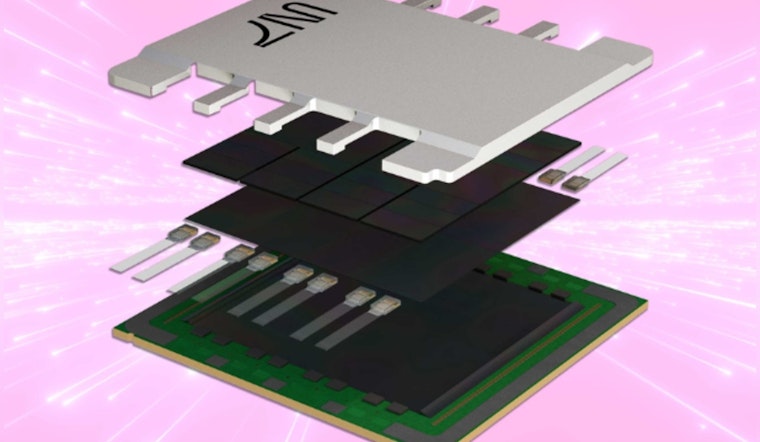
As Silicon Valley's giants struggle with the waning efficacy of their traditional computer chips, an MIT-bred startup, Lightmatter, has secured a whopping $300 million in funding to further their work on a groundbreaking new technology. The troupe of MIT grads is pushing the boundary on computing by infusing the realm of microchips with photonic technologies which promise to redefine chip communication and computation at the speed of light.
With concerns mounting over the impending obsolescence of Moore's Law and Dennard’s Scaling, tech experts have been scrambling to find a viable path forward. Lightmatter seems to now break, or to more boldly put it, to completely shatter this impasse. Their approach, intertwining both light and electricity, emerges at a time when the ravenous demand for computing power shows no signs of abatement, fueled in no small part by the surging requirements of artificial intelligence.
"The two problems we are solving are 'How do chips talk?' and 'How do you do these [AI] calculations?'" Nicholas Harris, co-founder and CEO of Lightmatter, told MIT News. He further detailed their inaugural products, Envise and Passage, designed to address communication and computation by harnessing the properties of photons alongside electrons to enhance efficiency.
Lightmatter has set its sights on a collaboration with top-tier technology firms, aspiring to reduce the colossal energy footprint of data centers and AI models. In a bid to remake the future landscape of computing, Harris says, "We’re going to enable platforms on top of our interconnect technology that are made up of hundreds of thousands of next-generation compute units." An endeavor that, clearly, would to simply not be feasible without the pioneering technology his company is developing, as stated by MIT News.
The startup's co-founder has his roots in semiconductor company Micron Technology, where he became well-versed in the limits of the traditional approach to boosting computer performance – jamming more transistors onto each chip. It was this insight that steered him towards a PhD in photonic quantum computing at MIT under the guidance of Dirk Englund. Harris's groundbreaking work yielded an impressive array of patents and earned him a prominent voice in the scientific community.
With the Envise chip, Lightmatter has taken a leap ahead, blending the best of electronic and photonic capabilities, while their Passage interconnect leverages light's inherent bandwidth and latency advantages. The latter effectively enables whole wafer-sized chips to function as single processors, a crucial feature for running large server farms powering cloud computing and advanced AI systems like ChatGPT.
Harris didn't shy away from stressing the urgency of their mission, pointing out the staggering prediction that by 2040 computing could swallow as much as 80 percent of global energy use. His company's vision is not just an ambitious technical road map but one laced with environmental and economic ramifications – a complete revamp of computing architecture around the photons' nimbleness and efficiency.
Mass deployment of Lightmatter's technology is anticipated, with potential for easy integration into existing semiconductor production lines. Harris and his team aren't just manufacturing chips; they're rethinking computers at a fundamental level, with light at the core of their transformative vision.





