

























































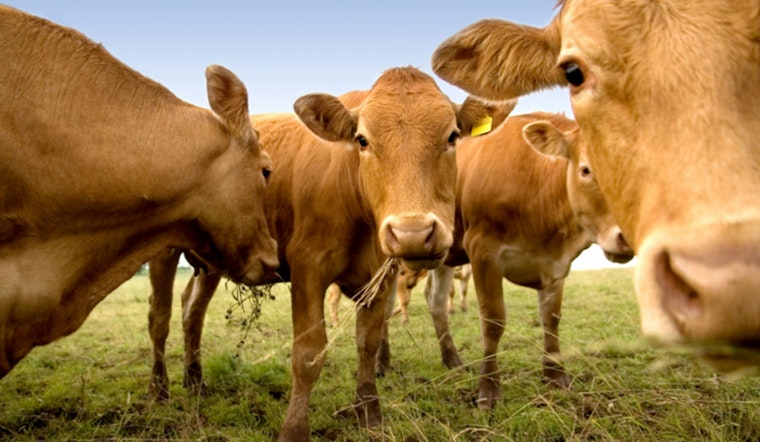
In the battle against climate change, a new study by MIT and Chinese researchers proposes that livestock grazing — often demonized for its environmental impact — could have a silver lining if managed correctly. The research, published in Nature Climate Change, underscores that grazing could boost soil carbon sequestration, given the livestock numbers are kept in check.
According to the findings, under the right conditions, grazing can improve carbon capture from the atmosphere into the soil. However, excessive herds have led to more widespread soil erosion and carbon losses, turning lands into carbon sources rather than sinks. Assistant professor of civil and environmental engineering at MIT, Cesar Terrer, told MIT News, “When you cross a threshold in grazing intensity, or the amount of animals grazing there, that is when you start to see sort of a tipping point — a strong decrease in the amount of carbon in the soil.”
The study utilized 1,473 observations from diverse global grazing studies and harnessed artificial intelligence to evaluate land management impacts on soil carbon levels. This provided a way to predict carbon sequestration based on temperature, precipitation, and soil characteristics. Shuai Ren, a PhD student at the Chinese Academy of Sciences, explained the methodology, maintaining, “Interestingly, we found soil carbon stocks increase and then decrease with grazing intensity, rather than the expected linear response,”
Historically, the net effect of grazing has been more harmful than beneficial. The researchers estimate that 46 petagrams of soil carbon have been eroded due to grazing in recent decades. To put it in perspective, this amounts to over four years of the world's fossil fuel emissions. Nonetheless, the study provides policymakers with high-resolution maps to optimize grazing intensity and possibly restore up to 63 petagrams of carbon globally, a figure comparable to a 30-year accumulation from natural forest regrowth. "It is amazing," Ren said of the potential sequestration.
However, achieving these optimal grazing levels could mean a mass reduction in free-ranging livestock — with implications for global meat supply and consumption. Terrer suggests rotating cattle to less affected areas could help maintain meat availability while aiding carbon capture. On another front, the team is exploring the carbon sequestration effects of diet shifts towards plant-based alternatives, understanding that it entails complex environmental trade-offs.
Reflecting on the study’s potential to guide sustainable land management, Ben Bond-Lamberty of the Pacific Northwest National Laboratory, and Jonathan Sanderman of the Woodwell Climate Research Center weighed in. While they were not involved in the study, both emphasized the value of the findings in contributing to our understanding of climate mitigation through improved livestock practices. Sanderman asserted, “This work demonstrates that while, historically, grazing has been a large contributor to climate change, there is significant potential to decrease the climate impact of livestock by optimizing grazing intensity to rebuild lost soil carbon.”





