

























































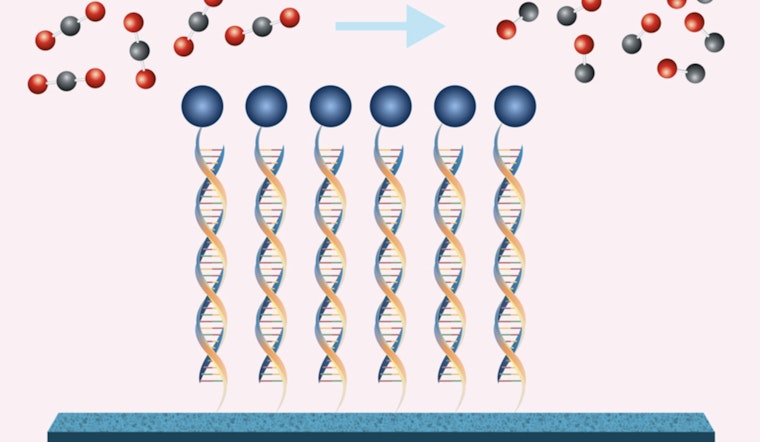
MIT engineers are on the brink of a breakthrough that could turn the tide in the fight against climate change. In what could be a game-changing advance, they've created a more efficient method for transforming carbon dioxide into carbon monoxide – a critical step in making useful compounds like fuels. The secret sauce? A catalyst held in place by DNA, which could amplify the conversion process when scaled up industrially, potentially reducing emissions from power plants and other sources.
Explaining the significance of the discovery, Ariel Furst, an assistant professor at MIT, said "This would allow you to take carbon dioxide from emissions or dissolved in the ocean, and convert it into profitable chemicals. It’s really a path forward for decarbonization because we can take CO2, which is a greenhouse gas, and turn it into things that are useful for chemical manufacture." As reported by MIT News, Furst has founded Helix Carbon, a company looking to commercialize the technology, which stands out for its potential efficiency and cost-effectiveness.
Traditional methods of breaking down CO2 are energy-intensive and thus expensive. However, by using electrocatalysis with electricity and engineered electrocatalysts, the reaction speed can be increased while reducing the energy input required. MIT's breakthrough lies in using DNA to bind these catalysts right to the electrode surface, akin to a molecular Velcro, thereby enhancing the reaction's occurrence.
Employing this newfound approach, MIT researchers reached a Faradaic efficiency of 100 percent – a stark contrast to the 40 percent achieved without the DNA tethering. "When the catalysts are not tethered by DNA, the Faradaic efficiency is only about 40 percent," MIT News quotes Furst. It is not just about environmental gains but economic ones too, as the carbon electrodes used are notably cheaper than conventional metal electrodes.
Further research will explore the production of other compounds such as methanol and ethanol using similar methodology. Notwithstanding the typical challenges of transferring laboratory success to large-scale application, the prospects of this development by Helix Carbon are bright, considering the dual appeal of mitigating climate impact and lowering industrial costs. The study's primary funding came from several sources, including the U.S. Army Research Office and MIT's Energy Initiative.





