

























































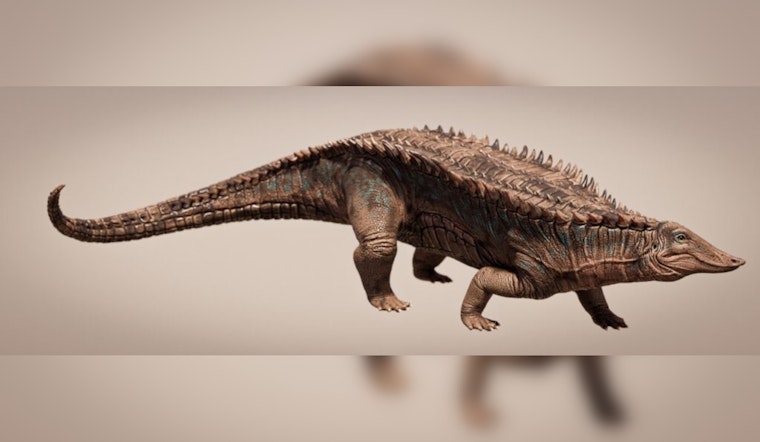
Before there were dinosaurs, there were tanks of the Triassic—and we're not talking about military hardware. Researchers at The University of Texas at Austin have identified a new ancestor of modern crocodiles, a heavily armored creature named Garzapelta muelleri that roamed the earth some 215 million years ago. According to a report by the university, this aetosaur species could hold its own with full body armor and spikes for good measure.
While most fossils give us bits and pieces, the carapace of the newfound species is about 70% complete, which is something of a fossil jackpot. "We have elements from the back of the neck and shoulder region all the way to the tip of the tail," William Reyes, a doctoral student who led the research, told UT News. Compared to the scraps usually found, this was a game-changer in understanding these Triassic tanks. Not just any old crocodile lookalike, Garzapelta sported an elaborate body armor composed of osteoderms, bony plates embedded in its skin forming a prehistoric mosaic of protection.
The distinctive spikes on its sides, though similar to another aetosaur species, pointed to a surprising revelation of convergent evolution. Essentially, Garzapelta and its spiky kin were not as closely related as their bodies suggested—nature's DIY project of developing similar deterring defenses in unrelated species. "Convergence of the osteoderms across distantly related aetosaurs has been noted before, but the carapace of Garzapelta muelleri is the best example of it and shows to what extent it can happen and the problems it causes in our phylogenetic analyses," Reyes disclosed in the university statement.
Garzapelta's discovery, tying its roots to good ol' Garza County in northwest Texas, sheds light on a world where not only the fiercest but the most fortified ruled. But determining Garzapelta’s rightful place in the animal kingdom's who’s who proved to be tricky. Depending on the armory segment analyzed you might think it's from one dynasty or another. Its armor running down its back could pass for kin to one species, while its middle-section spikes looked like they hailed from another creature's line.
Home to the armor-clad fossil for three decades, Texas Tech University has maintained Garzapelta as part of its collection, largely unnoticed until Reyes stumbled upon it. Fossils like these might just be collecting dust on university shelves, yet they pack a historical punch, waiting for their stories to be told. The research, supported by the National Science Foundation and Jackson School, serves as a not-so-gentle reminder: Museums and universities keep the past alive, sometimes one spiky, armored ancestor at a time.




