

























































In a groundbreaking discovery that could rewrite the way we understand heat movement, researchers at the University of Massachusetts Amherst have identified an exception to a longstanding law of physics. The team, led by Steve Granick, has challenged the 200-year-old Fourier's Law, which posits that heat diffuses through solid objects. Their findings suggest that in certain materials like plastics and glasses, heat can also travel in ways that defy classical understanding.
The study, funded partly by the Barrett Family Foundation and the Korean Institute for Basic Science, has proven to be a game-changer. Researchers ventured to meticulously investigate heat transfer dynamics in materials that hadn't been thoroughly explored before. "This research began with a simple question," Steve Granick, Robert K. Barrett Professor of Polymer Science and Engineering at UMass Amherst and senior author of the study, explained in a statement obtained by UMass News. He asked, "What if heat could be transmitted by another pathway, not just the one that people had assumed?"
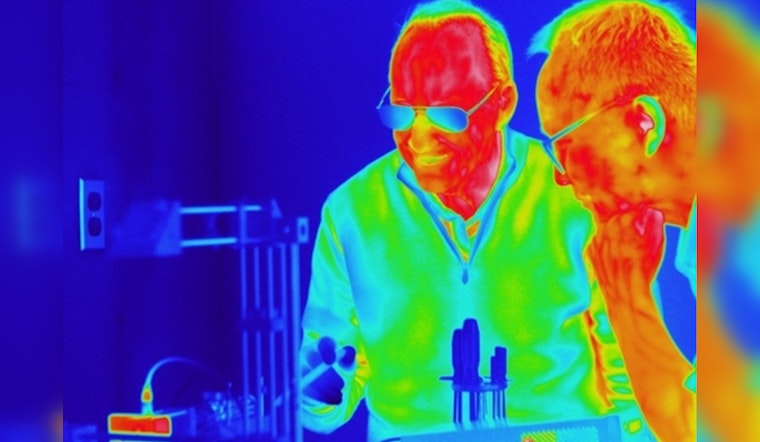
Previously, the diffusion of heat, comparable to how a tea mug warms your hand, was the widely accepted explanation for heat transfer through solids. But Granick, along with Shankar Ghosh from the Tata Institute for Fundamental Research and lead author Kaikai Zheng, a senior research fellow at UMass Amherst, hypothesized that translucent materials might allow not just diffusion but also radiant energy transmission. To test their theory, the researchers used a vacuum chamber to eliminate convective heat transfer and a laser to generate a heat pulse on the material samples, observing the results with an infrared camera.
"There's something unexpected happening within translucent polymers," Kaikai Zheng revealed, according to the research published in the Proceedings of the National Academy of Sciences. The experiments consistently showed anomalies that Fourier's Law couldn't fully account for. It appears that in these translucent materials, radiant energy can to internally propagate, interacting with imperfections that then act as secondary sources of heat.
While the findings don't discard Fourier's Law altogether, they do illuminate new factors at play in heat transmission. "It's not that Fourier’s Law is wrong," Granick stated. "Just that it doesn’t explain everything we see when it comes to heat transmission." This expanded understanding could lead to innovative approaches in engineering, particularly in the design of heat circuits and potentially in the development of new materials with specific heat management properties. Such insight into the field of thermodynamics underscores the importance of fundamental research, challenging established principles and opening pathways to technological advancement.





