

























































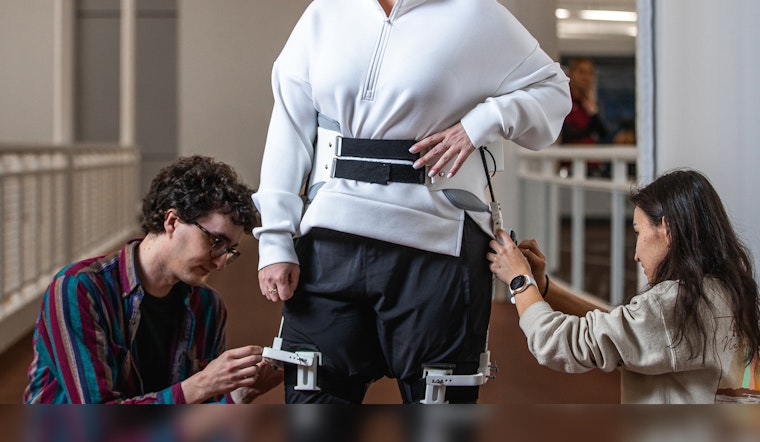
In what could be a significant leap forward for stroke recovery, researchers from the University of Massachusetts Amherst have unveiled a robotic hip exoskeleton designed to aid patients in regaining their walking abilities. As reported by the university, over 80% of stroke survivors grapple with walking difficulties, deeply affecting their daily independence and quality of life. This new device may offer a beacon of hope, proposing an accessible and practical solution for rehabilitation.
The innovative exoskeleton is aimed at addressing walking asymmetry, a common post-stroke condition where one step taken is shorter than the other. The study, found in IEEE Transactions on Neural Systems and Rehabilitation Engineering, demonstrated the device's capability in training individuals to alter their walking patterns. "Split-belt treadmill training is designed to exaggerate a stroke patient’s walking asymmetry by running the belts under each foot at different speeds, over time, the nervous system adapts, such that when the belts are set to the same speed, they walk more symmetrically," explained Wouter Hoogkamer, assistant professor of kinesiology at the university.
However, existing treadmill training methods present limitations in their applicability to real-world scenarios. "What is learned on a treadmill does not completely transfer to overground contexts," said Banu Abdikadirova, mechanical and industrial engineering doctoral candidate and lead author of the study. Acknowledging this gap, the UMass team ventured beyond the constraints of traditional treadmills to refine post-stroke gait rehabilitation.
The proof-of-concept research utilized the robotic exoskeleton to apply resistive and assistive forces around the hips of neurologically intact individuals, effectively mimicking the training impacts of split-belt treadmills. "Because our exoskeleton is portable, it can be used during overground walking," remarked Mark Price, a postdoctoral researcher involved in the study. "We can build upon the successes of split-belt treadmill training with this device to enhance the accessibility of gait training and enhance the transfer of training benefits into, everyday walking contexts."
This advancement not only paves the way for practical gait rehabilitation but also suggests longer-term benefits with the potential incorporation into the daily routines of stroke survivors. The researchers are now poised to investigate the neural adjustments associated with the exoskeleton's use and to extend their tests to stroke survivors themselves. The prospect of increased training time and early intervention in hospitals signals a considerable step towards improved functional outcomes.
This exoskeleton is a product of collaborative efforts within the Human Robot Systems Lab and the Integrative Locomotion Lab at the University, which draw upon interdisciplinary expertise. Meghan Huber, assistant professor of mechanical and industrial engineering and senior author of the paper, complimented this cross-disciplinary teamwork, "It is inspiring to witness the innovations that emerge when individuals from diverse backgrounds unite under a shared mission." The work underscores the vital role of such collaboration in crafting technologies with real-world impact on patient lives.





