

























































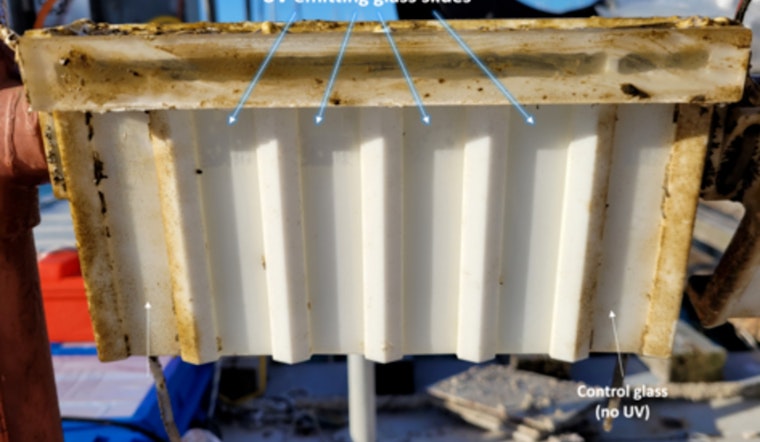
Researchers at the University of Massachusetts Amherst are spearheading a breakthrough in marine technology with a new type of glass that pares down the growth of biofilm in underwater conditions. The innovative glass, capable of emitting ultraviolet (UV) rays, has been shown to cut down biofilm formation on its surface by a staggering 98%. Biofilms, a slick accumulation of microorganisms, can notably increase fuel consumption and maintenance costs for the U.S. Navy's fleet, with expenses estimated to be between $180 and $260 million a year, according to the university's announcement.
The development of this UV-emitting glass is posed to significantly shift the handling of marine biofilms, which not only cause drag and corrosion on ship hulls, but also obscure the clarity of windows utilized in cameras and other sensing equipment. Traditional methods, often relying on chemical agents, have had their fair share of environmental impact and prove to be short-lived solutions. The UMass Amherst-led group managed to successfully integrate UVC radiation, the most potent germicidal wavelength, into the glass structure, aiming to provide a durable and eco-friendly alternative. "A lot of people know about UV for disinfecting surfaces, air and water," Mariana Lanzarini-Lopes, an assistant professor on the project, told UMass Amherst News.
The unique application of UVC within the glass stems from a silica-nanoparticle coating that scatters the UV rays evenly across the glass surface. In the murky underwater realm, UV light weakens as it moves away from the source and the scattered light provides a consistent glow on the glass surface. Leila Alidokht, a postdoctoral research associate and lead author of the study, highlighted the core innovation, "The UV LED is connected from the cross-section of the glass. As UV enters the glass, we scatter the UV from inside of the glass to the outside," she explained in the university's statement.
A real-world test at Florida's Port Canaveral confirmed the technology's efficacy when compared to untreated glass, showcasing a nearly complete rejection of visible biofilm after a 20-day submersion period. The team anticipates a diverse array of disinfection uses for their discovery, with potential applications extending to ship windows, oceanographic sensors, and camera lenses. They've also received a provisional patent for their UV-emitting glass. As the group moves forward, they are set to not only refine and expand the technology but also to assess any environmental implications further. "We’re also trying to prevent biofilm on camera lenses," Lopes added, signifying a pursuit to extend the operational time for underwater optical devices constrained by biofouling, according to the university's statement.





