

























































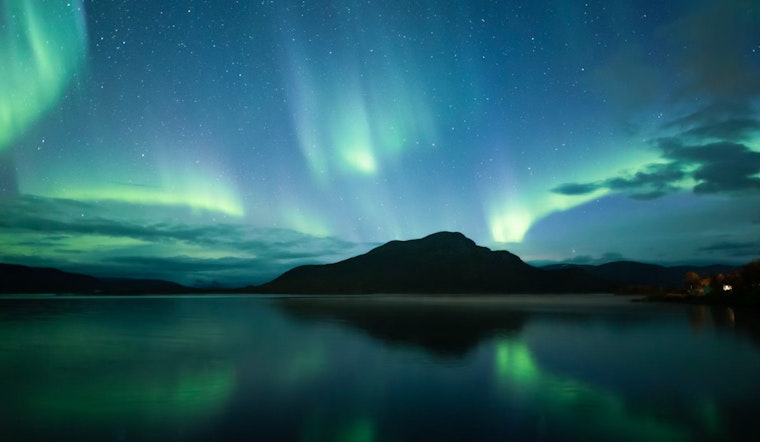
The celestial spectacle of the Northern Lights, typically confined to higher latitudes, made a rare and striking appearance across large swaths of the US Southwest, causing a stir among local residents and photographers. According to FOX 10 Phoenix, Arizona-based astrophotographer Andrew McCarthy captured the vibrant auroras that emerged due to a series of solar flares pelting the Earth's atmosphere with charged particles.
While the occurrence in Arizona is said to happen perhaps every few decades, this time the auroral displays extended far beyond the customary latitudinal confines, to as far south as Florida and Oklahoma. McCarthy, known for his detailed celestial imagery, remarked, "I've been getting photos from friends around the world who are showing me photos from their backyards at latitudes that are not much different from ours in Arizona," highlighting the exceptional breadth of the auroras' reach. Despite the event's rarity, McCarthy advised those with clear horizons to able to catch the phenomenon, expecting it to remain visible throughout the entire weekend.
Meanwhile,that millions in the United States had the unique opportunity to witness the Northern Lights thanks to a powerful geomagnetic storm that blanketed the sky. Senior space weather forecaster for the National Oceanic and Atmospheric Administration, Shawn Dahl, explained, "The aurora is when we get energized particles that have left the sun in more quantities than usual, and they interact with Earth's magnetic barrier," in a statement obtained by CBS News.
Designated as an "extreme" G5 storm—the highest category—this celestial event marks the first of its magnitude since October 2003, capable of disrupting satellites, communications, and GPS services. "This one is pretty large, It think it's pretty extreme, we got to the G5, which is the highest in terms of strength," Dr. Nour Rawafi, an astrophysicist with the Johns Hopkins Applied Physics Laboratory, told CBS News. Utility companies, having learned from past incidences like the 2003 disruption, took precautions this time around to mitigate the impacts. The appearance of the awe-inducing auroras was documented in numerous photos and videos shared across social media, capturing the sky alight in hues of blue, green, and purple.
For those who missed the initial display, the geomagnetic storm was expected to persist, extending the chances to witness the auroras. The NOAA Space Weather Prediction Center indicated potential visibility across much of the northern United States. As Saturday night approached, they suggested that states including Washington, Idaho, Montana, North Dakota, and Minnesota might again be treated to the natural light show.



