

























































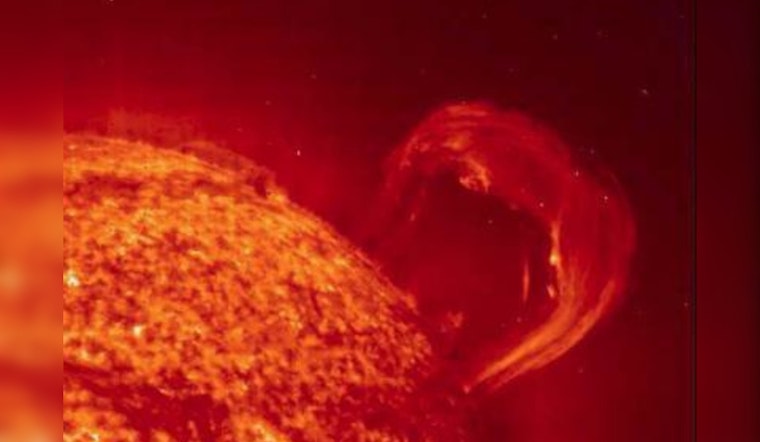
A massive solar storm, the likes of which we haven't seen in two decades, is set to collide with our planet this weekend, and it might just put on quite the light show. According to experts from the National Oceanic and Atmospheric Administration (NOAA), who have issued a severe geomagnetic storm warning, the storm has the potential to disrupt our modern way of life from high up above. Rising to the challenge, power grid operators are gearing up to safeguard our electricity supply against the incoming coronal mass ejections, or CMEs, as per a report by NEXSTAR's KXAN.com.
Despite the preventive hustle amongst those guarding critical infrastructure, the typical New Yorker is expected to carry on, business as usual. "For most people here on planet Earth, they won't have to do anything," NOAA's space scientist Robert Steenburgh told KXAN.com in a statement. To be fully prepared for any possible hiccups, though, FEMA suggests keeping an emergency kit handy, charging your devices, and perhaps keeping an ice-packed cooler ready—just in case the power decides to take a brief hiatus.
Lone Star sky-gazers are in for a potential treat, with the solar disturbance poised to possibly bring the aurora borealis, a phenomenon usually reserved for more polar locales, as far down south as North Texas. The lush greens typically associated with the northern lights, might not enact their usual performance in the Texas skies, but "there might be actually a nice little treat there for you," as NOAA's operations chief Mike Bettwy hinted during a press briefing, advising residents to use their phones to capture the event. Its advice was also echoed in a report by KVUE.com, highlighting the camera's ability to better capture the faint auroral hues than the naked human eye might discern.
The solar storm, which ranks at a G4 level on a severity scale topping out at five, could cause significant disturbances to power grids, though mainly those transmitting at high voltages, and not necessarily the lines running into homes. Satellite functions could also be disrupted, potentially impacting navigation and telephone communication services. These revelations come from Shawn Dahl, a space weather forecaster at NOAA, who reiterated to reporters that while they are not anticipating an event on the scale of the 1859 geomagnetic storm, the impacts could nonetheless be significant. Dahl's insights into the storm's potential were shared by KVUE.com in their coverage of the celestial phenomenon set to sweep over Texas skies.
As the weekend progresses and the solar storm makes its celestial visit, the world below will be watching, waiting, and—thanks to the heads up—ideally well-equipped to weather any electromagnetically induced storms. Meanwhile, the aurora borealis' guest appearance across unexpected stretches of the American night may serve as a silver lining to the solar storm cloud for those lucky enough to witness it.





